Thursday, January 21, 2016

Getting grounded

Ideas, techniques and inspiration

Felted dragon and gnomes
by Jennifer & Melissa VanSant, Going Gnome
With four years now under our belts, attendance at Vogue Knitting Live New York has become a very special time for me to learn and be inspired by some of the best knitting instructors in the world. 

Although Kris and I could make the event a day trip, we splurge and stay one night. This allows us to have two days of classes. I oversubscribed myself....again....with a total of four classes and one lecture. Kris did the same. That meant we had four different instructors. Some were outstanding. More on the topic of teaching another time.


Lion Brand Yarn's
'Produce Stand'

Market madness

The public areas feature special exhibits such as the felted dragon and gnomes (right) and Lion Brand Yarn's produce stand (below). Although some were simply displays, most were devoted to business-minded fiber artists. Some, like Jennifer and Melissa VanSant of Going Gnome, and Ruth Marshall, who hand knits pelts of exotic endangered animals such as the clouded leopard (below), offer kits. 

The Marketplace grows year over year growing Vogue's revenue streams and offering shoppers a wider range of goods. There is an extensive variety of yarns, tools and supplies in ballrooms on two floors. This year added spaces in an area adjacent to one of the ballrooms. The market is definitely worth visiting, but it gets crowded....as in crushingly crowded. Next year I plan to leave at least one class time open time so that I can spend some time in a less crowded market. Maybe I'll even buy something.

Machine magic

Silver Reed knitting machine
Susan Guagliumi's machine knitting refresher class was my first choice among all choices. I had been shut out in past years and looked forward to a morning of immersion. The morning course was exactly what I wanted--and needed. I have a knitting machine--a fabulous Passap Duomatic 80 acquired many years ago. They are no longer manufactured although they're workhorses and plenty are still in use. I found one in the Virtual  Knitting Machine Museum that made me feel, well, old. 

I knit on the Passap machine a great deal during our years in London but slacked off after returning to the States for no other reason than that life intervened. Although not stored under my bed, it might as well have been. Thanks to Son #1 and Son #2, it is now accessible. (As my knitting machine is not transportable, I am particularly thankful to Stitcher's Dream, Lansdale, Pa. for providing Silver Reed knitting machines for the classes.)

I have long struggled to understand the low interest in knitting machines. Susan Guagliumi, whose knowledge of machines is both broad and deep, attributes the decline to the output of ugly garments knit in acrylic and mostly in Fair Isle. 

Knitting machines can be workhorses. Sure, they can knit garments--and knit them beautifully if executed properly, but they offer much more versatility than that. I find my machine a perfect companion for finishing hand wovens and it's the perfect tool for hand knit projects with brutally boring expanses of a single stitch type. 

Now that I'm home, I can't wait to get the machine working. Yes, I have a re-learning curve, but I'm motivated. Really motivated. And after hearing a lecture by Laura Bryant, I think I have the perfect project.


Finishing School

Finishing techniques were my other focus for the weekend. This is an ongoing interest as it  can make a difference between a garment that looks like it was 'made by loving hands at home' and a hand crafted knit. 

Sample for Finishing School

My class, "Finishing School," with Deborah Newton was excellent. Prep for the class was a large, square, blocked sample that had a cable in the middle with 4 inches of a small all over pattern on each side. (I used a small basketweave)  In class, we practiced her recommended seaming technique on about two inches of it. To get the full benefit of the class, I need to follow through on her directions to try out the other techniques. 

My biggest take-away is a new perspective on blocking, especially wet blocking. "Blocking isn't necessary," Newton  advises. "Maybe a light steam, if the fabric is appropriate." Also, she says she has no special tools and recommends none--a reassuring note in the midst of a market mania.

Taking instructors home with me

I was so impressed with three instructors that I came home and ordered their books. In addition to Deborah Newton's "Finishing School" and Susan Guagliumi's books on machine knitting, I ordered Laura Bryant's "Artful Color, Mindful Knits: The Definitive Guide to Working with Hand-dyed Yarn," after hearing her speak and seeing the jacket she was wearing. I expected a pattern book, but no! This book is a gold mine for anyone who hand dyes yarn for their craft. The knitting patterns are a bonus.

Thursday, January 14, 2016

She made me do it

The continuing saga of knitting socks

The hand knit sock that started it all

I swore I'd never, ever, ever knit a sock. That was before I owned a pair. 

After my daughter knit a pair for me, I was converted to the unquestionable value of hand knitted socks.

And to wear them, I needed to knit them. 

And I have. Thing is. I don't feel as if I've mastered socks. Oh, sure. I've knit socks. I've knit them from the top down and from the toe-up. I've knit them singly and two-at-a-time. I've knit them on double pointed needles and on circular needles, in different patterns and with a variety of heel and toe structures. But I still feel like the sock knitting newbie.  

Here's why: I have yet to knit a pair of socks that I'm 100 percent happy with. Now you probably know by now that I'm a nitpicker. Stitch off way back in row 3? I see it from 10 feet and hate it. Always will. Ditto for too-tight cast-ons, unbalanced gussets, etc. Still, I keep trying to grant myself the freedom to overlook and accept imperfections.


Perfect as the enemy of good

Years ago I took pattern making classes with a teacher who had a starkly different approach to finished garments. She focused on the fit and how it looked. She wasn't at all bogged down by construction mishaps. Didn't go together quite like you wanted? No problem. Tack it. Glue it. Fix it with safety pins. Whatever. Make it look good from the outside and move on.

Whenever I see a mishap--knitting, sewing, weaving, whatever--and begin my bout of angst about it, I try to channel that woman's approach. Not always successfully, mind you, but I keep trying.


Needles in motion

I recently started knitting a sock with a lovely lace pattern. I still am striving to knit that perfect sock, but there is another reason. Socks are ideal projects for travel. They're small and suitable for picking up and putting down at a moment's notice. 

You see, Vogue Knitting Live New York is this weekend. It's an event I look forward to from year to year not only because of the intoxicating and infectious atmosphere, but because it's time to spend with my daughter. Precious time. 

Granted, there is precious little time to knit, but should I find myself with a few minutes spare or needful of a little quiet focus, I can whip out my half-finished sock. It's unlikely that I will knit more than a few rows, but you never know. 
"Welt fantastic" pattern tames yarn with color variations

Thursday, January 7, 2016

Patterns in fashion

Pattern books revolutionize textile art and craft

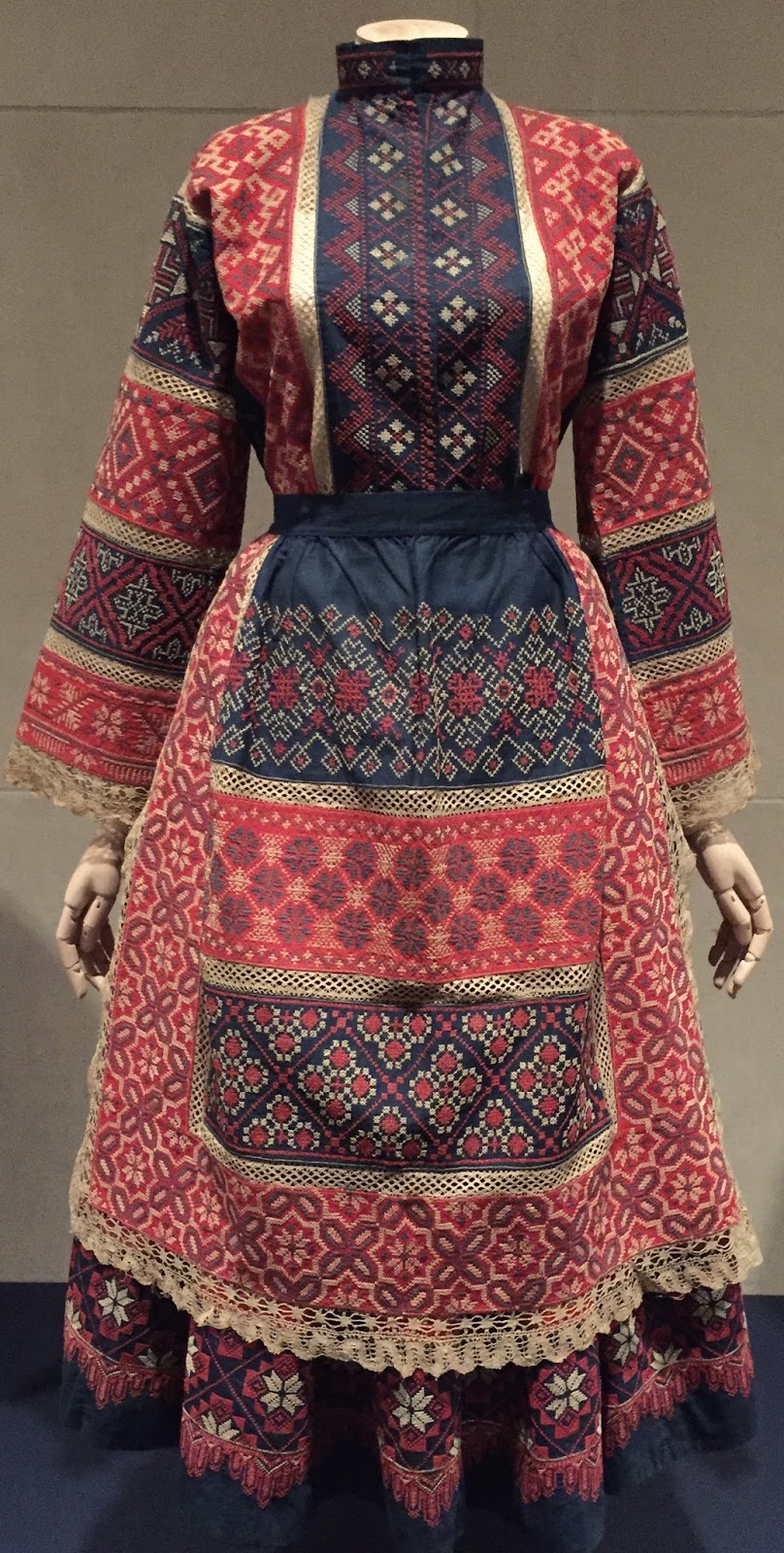
Antique patterns in traditional and designer garments. 
L-R: Embroidered thobe, Palestinian, early 20th C.
Russian ensemble, embroidery and lace, early 20th C.
American designer Giorgio di Sant'Angelo, 1970
The Metropolitan Museum of Art (MMA) has a significant collection of textile pattern books. These early examples of patterns form the basis for their current exhibit, Fashion and Virtue. Textile Patterns and the Print Revolution, 1520–1620, around which the curators have tied the past to the present.

This show focuses on patterns and specifically on  print patterns that were published to be destroyed. Not malicious destruction, of course, but the patterns were intended for use so the pages were typically torn out and used as patterns for all sorts of textile decoration and embellishment, including embroidery, lace, cutwork, etc. Consequently, not many of these pattern books exist.

It seems to me that exhibits based on books would be a challenge. A book is a unit composed of individual pages. How do you display a page or two to convey the book's value and importance? In this exhibit, the curators displayed the patterns as worked into finished items--garments, accessories, etc.

When I see patterns like this--in books (like Dover's Design Library), on objects and garments of all sorts, and in exhibits like this--I see design opportunities. For example, the print squares with a rose in the centers as well as embroidered design on the smock undergarment on display makes me think of cables. 
Embroidered undergarment,
detail 
Printed pattern
Embroidered Russian ensemble
Early 20th century
One section of the exhibit that I very much liked was one woman's collection of antique handwork fragments. Each piece was mounted with its print pattern and documentation. (I regret that I did not note her name.)

MMA is doing an excellent job of digitizing their collections and making them available online. Click here to view a selection of items in the exhibition.

(PS: The use of 'virtue' in the exhibit's title was an interesting choice. Although needlework was seen as a virtuous endeavor for young ladies after men left the craft to pursue more lucrative jobs, 'virtue' was neither the main theme of the exhibit nor the unifying thread that tied published patterns to the textile patterns.)

Thursday, December 31, 2015

Documented works

My Weaver's Record Sheet

Do you regularly record project details?


Think you'll remember the needle size you used to knit that sweater you just finished? What about the project to set aside last week? Or how about that hat you made last year? Doubtful. Highly doubtful.

If you knit or crochet and are part of the Ravelry community, one feature of the site is a customizable project section to record relevant details on projects. 

Your personal project page has spaces for the essentials--yarn used and how much, needle size, pattern source and size, as well as the important text box for notes. There are many other details, most of which are 'nice-to-have's' and helpful to others interested in the item, but these are the most important in my opinion. 

If you're not already taking advantage of this feature, consider using it to record project details. Maybe a New Year's resolution? (If you don't belong, join. It's free.)

Weavers have an online resource at Weavolution, but it's neither as clean nor as easy to use as the "add project" page on Ravelry. I did find a good thread regarding records sheets there. A number of group members recommend record sheets found in popular weaving books and point out that many current weaving software programs include record keeping templates. 

Some guilds have developed and/or adapted record sheets and make them available for download from their website. For example, the Handweavers Guild of Boise Valley (Idaho) has weavingspinningdyeing and braiding records.  They also have developed a weaver's Project Planner in Excel for a project, but it does not include the drawdown or calculations. Use their Weaving RecordWeaving Record Drawdown and Weaving Yarn Calculation for the range of data needed.

For weaving I use a record sheet (above) that suits my personal needs. It's really a combination of the Boise' Guild's Project Planner, standard weaving record sheets and drawdowns and is closer to the weaving record sheet offered by the Williamsburg Spinners & Weavers Guild, accessible here

For spinning, dyeing and braiding, I prefer to make records on 4x6 index cards. I make a master with the relevant information I want to capture and print it on blank cards. Of course, I update the master regularly, but having a master makes it as easy as possible to enter the data as well as to use it later.

Documentation is important

Please oh please document your work. Documented work has value not only to you, but also to others. The New York Guild of Handweavers has an impressive collection of weaving samples. Unfortunately, many are missing documentation. No names. No weave structure. No threading or treadling guides. They aren't much good as a resource....yet. The Guild has begun a study group to identify the patterns. It is a huge task.

Whether you download a form, make your own template, or keep a spiral notebook doesn't matter. The thing that matters isn't the method. It's the documentation. And, oh yes! Be sure to photograph your work and attach it to the document. It's your body of work. It is important.

Thursday, December 24, 2015

Antique textiles reborn

Surrounded by antique woven and embroidered treasures

Antique textiles as home decor
By now you know that I love beautiful textiles. But the love sometimes surpasses practicality and/or timeliness.

Such is the case of three discarded beauties. The textiles were remarkable but sadly they had outlived their intended uses.

One, which I bought at an auction, was red and a very large square paisley shawl  woven of fine silk and wool, ca. 1860. Its plain weave red center, visible on the top center pillow, was bordered with intricately woven designs on all four sides. 
Kashmir wool embroidery, detail

The second called to me at a yard sale. The large Kashmir wool chain stitch embroidery wall hanging had been badly damaged at its midpoint where it had clearly been folded for a long period of time. (A sad reminder never to fold valuable textiles--Roll them up!) I estimate that it was made in the late first to mid-second quarter of the 20th century.

The third textile consisted of two rectangular sections of a wool paisley shawl. I don't remember where I got them, but they're circa late 19th to very early 20th century. The pieces were in good condition and showed the original shawl's solid black center as well as its lovely deep, rich red and dark green intricately woven border design. They were undamaged but only 12 inches wide.


Despite the damaged areas on the red shawl and the Kashmir embroidery, there were plenty of areas in good condition. The colors were vibrant and designs exquisite. Beautiful textiles to live with and enjoy. I could envision them as pillows. 


Textiles transformed

Pillows from two ladies' paisley shawls
Unfortunately, as often happens, my mind provides more ideas and warps time to cause me to think I can achieve more than humanly possible. I tend to live in this state.

So, after a life change early in 2015,  followed by a studio clean-up and -out, a major goal was to finish neglected projects. The three textiles were at the top of the list. They occupied valuable space. I needed them finished and out the door! 

Easier said than done, of course. 

Then I got a deadline. (Yes, yes. I'm very deadline-driven.) K. had a booth at a local craft fair and offered to share it with me. This gave me a date to finish them.

I loved the textiles when the only thing to love was the intricate and beautiful work--and I love them even more as beautiful pillows. But I can't possibly use all the pillows I have, so, yes, they're for sale. Time and place yet to come.

Monday, December 21, 2015

Wrapped in luxury

Wear a fur as if it is cloth, and cloth as if it were fur.

Paisley shawl, detail. ca. 1860.
It's an old saying that I have always loved as it speaks to how a woman wears a coat. She wears the coat. The coat does not wear her. 

I have no opposition to fur coats, but I've never wanted one. Perhaps if I lived in a very cold climate, I'd feel differently. But I don't.

This gives me far more latitude (If I had a fur coat, I'd feel obliged to wear it at every opportunity) and allows me the luxury of wearing my personal treasures more often. 

To me, there is little more satisfying than wearing a spectacularly beautiful textile. I appreciate hand crafted textiles, like the poncho from the women's co-op in Inga Pirca, Ecuador where they raise and shear the sheep, spin the wool, weave the fabric and make the garment. Also from Cuenca, Ecuador, I have an irate poncho. There is a beautiful embroidered jacket from Guatemala and a scarf from Japan dyed with cherry blossoms, to name but a few. They are my treasures.


Paisley shawl, ca. 1860.

A spectacular paisley shawl


One particular treasure is my antique paisley shawl. While living in London, I had deeply admired the antique paisley shawls in markets and developed a real love of them in their many forms. Small and large squares and rectangles. I loved them all. But I never bought one. They were very dear.

After returning to the States, we saw a particularly beautiful and pristine shawl at an antique fair. Secretly M. purchased the shawl and gave it to me for Christmas. He also crafted a lovely cedar box in which to store it.

My wool shawl is large--72 inches square--and woven of very fine wool. Sometimes I wonder whether it was purchased here in the U.S. or brought in a trunk. Where was it worn? and what could she tell me? These--and other  stories--are all unseen yet woven into the shawl.

I absolutely love my shawl and wear it whenever the occasion and the weather permits. And when I wear it, I feel special. And why shouldn't I? I'm wrapped in luxury. 


Thursday, December 3, 2015

Sights and sounds

Where textiles were hiding in plain sight

Puchari. Jill and Sheldon Bonovitz Collection
I didn't expect to find textiles on the walls at the Curtis Institute of Music, but there they were. Beautiful. And I hadn't even noticed them when entering the recital hall.

A fit of coughing caused me to miss the last performer and the encore of the  Opera Philadelphia recital, but the near empty reception area gave me space to notice the pulcharis. First one. Then more!

The large rectangular wall hangings are from the Jill and Sheldon Bonovitz Collection. Embroidered in rich, vibrant colors the pulcharis are unique to the Punjab and worked in a technique also known as pulchari, or flowering work. The stitched designs represent good fortune, health and happiness, according to the information signage accompanying the works.

Worked from the back in brightly dyed, untwisted silk floss, pulcharis feature floral and geometric patterns and were made during the 19th century and well into the 20th by Punjabi women of all backgrounds and religions. 

According to information posted with the pulcharis, they were commonly worn as head coverings by the women for special rituals and events. (The Minneapolis Museum of Art has a particularly beautiful 19th century pulchari veil made of camel hair and gold thread.) Also, some pulcharis were made to celebrate a special occasion, such as a marriage or a birth. And others were made for temple offerings or ritual wall hangings or canopies.

In the Punjab, women began stitching for a woman's trousseau--for a girl--or as a gift to the groom's parents for a boy. Folk songs and stories record that dreams and desires of the woman were stitched into the pulcharis, which may account for subtle changes in the work throughout the time it was being crafted.

It was a treat to stumble upon this group of generously shared pulcharis. And it was a reminder for vigilance. Beauty surrounds us, if only we take the time to look.
Puchari. Jill and Sheldon Bonovitz Collection