Showing posts with label embroidery. Show all posts

Thursday, January 7, 2016

Patterns in fashion

Pattern books revolutionize textile art and craft

Antique patterns in traditional and designer garments. 
L-R: Embroidered thobe, Palestinian, early 20th C.
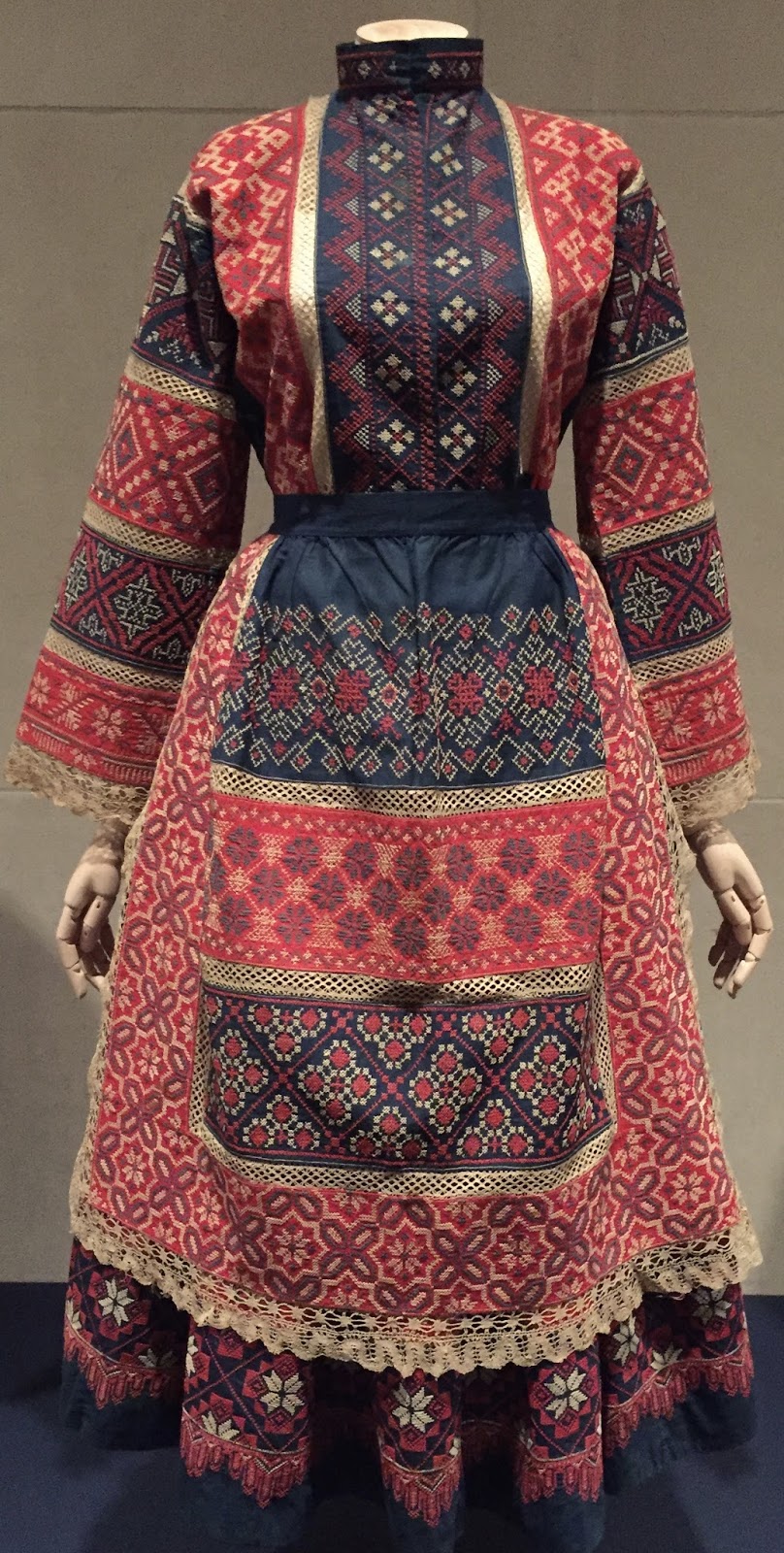
Russian ensemble, embroidery and lace, early 20th C.
American designer Giorgio di Sant'Angelo, 1970
The Metropolitan Museum of Art (MMA) has a significant collection of textile pattern books. These early examples of patterns form the basis for their current exhibit, Fashion and Virtue. Textile Patterns and the Print Revolution, 1520–1620, around which the curators have tied the past to the present.

This show focuses on patterns and specifically on  print patterns that were published to be destroyed. Not malicious destruction, of course, but the patterns were intended for use so the pages were typically torn out and used as patterns for all sorts of textile decoration and embellishment, including embroidery, lace, cutwork, etc. Consequently, not many of these pattern books exist.

It seems to me that exhibits based on books would be a challenge. A book is a unit composed of individual pages. How do you display a page or two to convey the book's value and importance? In this exhibit, the curators displayed the patterns as worked into finished items--garments, accessories, etc.

When I see patterns like this--in books (like Dover's Design Library), on objects and garments of all sorts, and in exhibits like this--I see design opportunities. For example, the print squares with a rose in the centers as well as embroidered design on the smock undergarment on display makes me think of cables. 
Embroidered undergarment,
detail 
Printed pattern
Embroidered Russian ensemble
Early 20th century
One section of the exhibit that I very much liked was one woman's collection of antique handwork fragments. Each piece was mounted with its print pattern and documentation. (I regret that I did not note her name.)

MMA is doing an excellent job of digitizing their collections and making them available online. Click here to view a selection of items in the exhibition.

(PS: The use of 'virtue' in the exhibit's title was an interesting choice. Although needlework was seen as a virtuous endeavor for young ladies after men left the craft to pursue more lucrative jobs, 'virtue' was neither the main theme of the exhibit nor the unifying thread that tied published patterns to the textile patterns.)

Thursday, December 3, 2015

Sights and sounds

Where textiles were hiding in plain sight

Puchari. Jill and Sheldon Bonovitz Collection
I didn't expect to find textiles on the walls at the Curtis Institute of Music, but there they were. Beautiful. And I hadn't even noticed them when entering the recital hall.

A fit of coughing caused me to miss the last performer and the encore of the  Opera Philadelphia recital, but the near empty reception area gave me space to notice the pulcharis. First one. Then more!

The large rectangular wall hangings are from the Jill and Sheldon Bonovitz Collection. Embroidered in rich, vibrant colors the pulcharis are unique to the Punjab and worked in a technique also known as pulchari, or flowering work. The stitched designs represent good fortune, health and happiness, according to the information signage accompanying the works.

Worked from the back in brightly dyed, untwisted silk floss, pulcharis feature floral and geometric patterns and were made during the 19th century and well into the 20th by Punjabi women of all backgrounds and religions. 

According to information posted with the pulcharis, they were commonly worn as head coverings by the women for special rituals and events. (The Minneapolis Museum of Art has a particularly beautiful 19th century pulchari veil made of camel hair and gold thread.) Also, some pulcharis were made to celebrate a special occasion, such as a marriage or a birth. And others were made for temple offerings or ritual wall hangings or canopies.

In the Punjab, women began stitching for a woman's trousseau--for a girl--or as a gift to the groom's parents for a boy. Folk songs and stories record that dreams and desires of the woman were stitched into the pulcharis, which may account for subtle changes in the work throughout the time it was being crafted.

It was a treat to stumble upon this group of generously shared pulcharis. And it was a reminder for vigilance. Beauty surrounds us, if only we take the time to look.
Puchari. Jill and Sheldon Bonovitz Collection

Monday, March 23, 2015

Sleeping beauties


Embroidered pillow case,, detail. c.1955
Photo by Maurice Marietti
Did you have a hope chest? I didn't, but I was clearly at the end of an era. When I graduated from high school in 1961, every graduating woman received a silver teaspoon in a pattern of her choice and a miniature Lane cedar chest from a local merchant. 


Embroidered pillow case. Flower basket.
c.1955. Photo by Maurice Marietti
It was expected that each would marry soon, complete the silver setting and purchase a full size cedar hope chest in which to store her linens. Some did. 

In preparation for marriage, young women were expected to bring to marriage a hope chest filled with basic homemaking needs. One of these was bed linens. 

Well before high school, my grandmother nudged me into compliance with preparation for domesticity. She gently advised me that I would need nice pillowcases and guided me to patterns that my young fingers could execute. (Of all the stitches, French knots were my Waterloo.)

No surprises that kittens were a pattern chosen by a 12-year-old. I didn't really mind working them, but tomboy that I was, embroidering items I never intended to need was definitely not a priority. Let's just say, they languished in drawers, but I did complete two sets of pillowcases because I have them. Both are obviously the work of a neophyte embroiderer.


Pillow case, crocheted edge. c.1950.
Photo by Maurice Marietti
In a giant leap to skilled needlework are my grandmother's worked pillow cases. I have three. Surely they, too, were intended for my hope chest. There are three sets. The hem of the one at right has been cut in a "V" shape with a simple crocheted edging to finish.


Pillow case, cut work. c.1950.
Photo by Maurice Marietti
Another is cutwork, a surface embroidery technique in which sections of the fabric are cut away and the edges reinforced with a simple buttonhole stitch. Although difficult to see in the photo, the design is reminiscent of a southern belle with a broad skirt and flowers flowing from her shoulders.
Pillow case, crocheted edge and
butterfly c.1950.
Photo by Maurice Marietti

And here is another butterfly! Last week, my blog included a lady's handkerchief with a butterfly motif. This one differs in that the butterfly is  sewn onto the pillow case. Its antennae were embroidered on in with a running stitch. It matches the crocheted edging. 

These very ordinary pillow cases are part of my treasure trove. Of little real value, they are special to me alone. I'm surprised that I have saved them as most--if not all--have never served any useful purpose. And yet, they have traveled with me for many years and over many miles. They are part of me.


Embroidered pillow case. c.1955
Photo by Maurice Marietti