Showing posts with label lace. Show all posts

Wednesday, May 25, 2016

Sock 'em to me


Two tips for knitting lace socks 


Oriel lace patterned socks
As the weather warms here on the East Coast, I'm not thinking much about wool or wool socks and I must remind myself: It is exactly the time to think about them in time for the first chilly days.

I love textured patterns but it took me too long to realize my love of lace-patterned socks. The first lace socks I knit were in  the Oriel pattern from Charlene Schurch's Sensational Knitted Socks. From there, I was hooked.

Knitting socks is not a priority. In fact, they just barely make the list of handwork. Typically theyre m'y low-key, go-to project when I'm too tired to do much of anything else. I don't care how long it takes me to knit a pair of socks. It might be months. That's OK. 
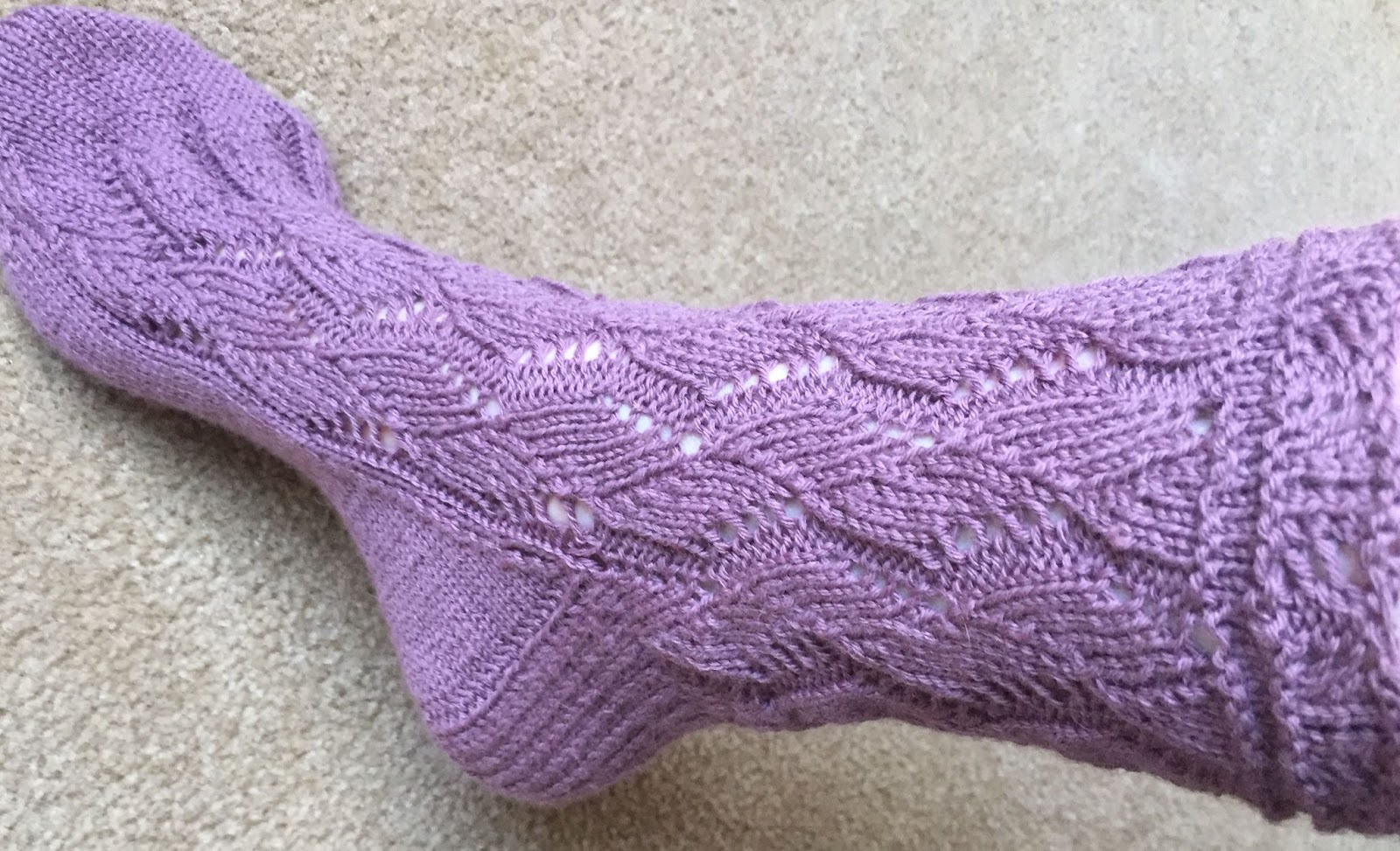
Waving Lace patterned socks
Currently on the needles is the second of a pair in Evelyn Clark's Waving Lace pattern from Interweave Press' Favorite Socks: 25 Timeless Designs from Interweave. I love the picot cuff design on these, too.

I've learned so much about knitting socks by....knitting them, of course! Two recent ah-ah's related to my lace sock knitting are fit and blocking/drying.


Lace patterned socks to fit

Check the fit before knitting to the measured foot length. Fortunately, I checked the first sock of Oriel before finishing it off. (It is a top-down). I had knit to my tried-and-true foot measurement--like I had knit my other socks--but fortunately tried them on before finishing. I had gone too far. As lace stitches stretch much more than most other stitches (I know, I should have thought of this from the cast-on), the sock was about an inch too long. I tinked about an inch before finishing and it's a perfect fit. Good lesson. I won't forget.
Sock blockers/dryers 


Blocking/Drying hack

I'm not totally convinced a blocker is necessary for most sock knitting with today's yarns, so I've been hesitant to purchase a set. My wire frame allows socks to dry perfectly and if they also block them, it's a plus. I used two coat hangars, bending them into a general sock shape. They work perfectly. They can be hung for the socks to dry and they store equally easily.

Thursday, May 19, 2016

Lacey compromise

Lace shawl No. 1

About 50 more yards would have been better


I thought I had plenty, but those outside edges gobbled even more yarn that I'd estimated. About 20 rows from the planned end, I could see the yarn disappearing too quickly. I measured and estimated whether or not I'd have enough yarn.* But I was overly optimistic.

Even after cutting the number of rows I found myself facing the yarn's end about halfway through bind-off. I backed up, tinked a couple rows and bound off again. 

OK. I compromised on the bind-off, using less than I should have and getting a less-than ideal edging. After all those yarn-overs, knit-two-togethers and double decreases, there are no gorgeous points on the outer edge. A disappointment, to be sure, but if I didn't confess, it might appear that I planned it that way.

Triangular lace scarf

Working down the stash mountain

In my stash was one skein of Pepperberry lace weight cashmere yarn, which I had purchased at Vogue Knitting Live 2015. The intent was to make a smallish triangular scarf  that could be worn as an accessory at the neck. The skein  had 366 yards, which seemed enough for the small size I planned. And it certainly might have been.

However, I used this scarf to work through an evolving design idea that involved multiple pattern transitions. So it wasn't one that worked especially well with planning ahead.

Overall, I'm pleased with the result. I made copious notes so, after I organize them and incorporate my changes, I will update the pattern to make it easy to follow. Then I  want to knit the design with my single ply homespun. 

When I have something to share, you'll see it here first.


*How I estimated yarn needed for completion: 

I measured about four yards of as-yet-unknit yarn from the needles and made a small slip knot. I knit one row in pattern. Depending on how much was left of the measured yardage (or needed to be added), I added a factor of 10 percent and multiplied the result by the rows yet to knit. 
Formula: [Measured yards + 10%] x Number of rows remaining in pattern.

Thursday, January 7, 2016

Patterns in fashion

Pattern books revolutionize textile art and craft

Antique patterns in traditional and designer garments. 
L-R: Embroidered thobe, Palestinian, early 20th C.
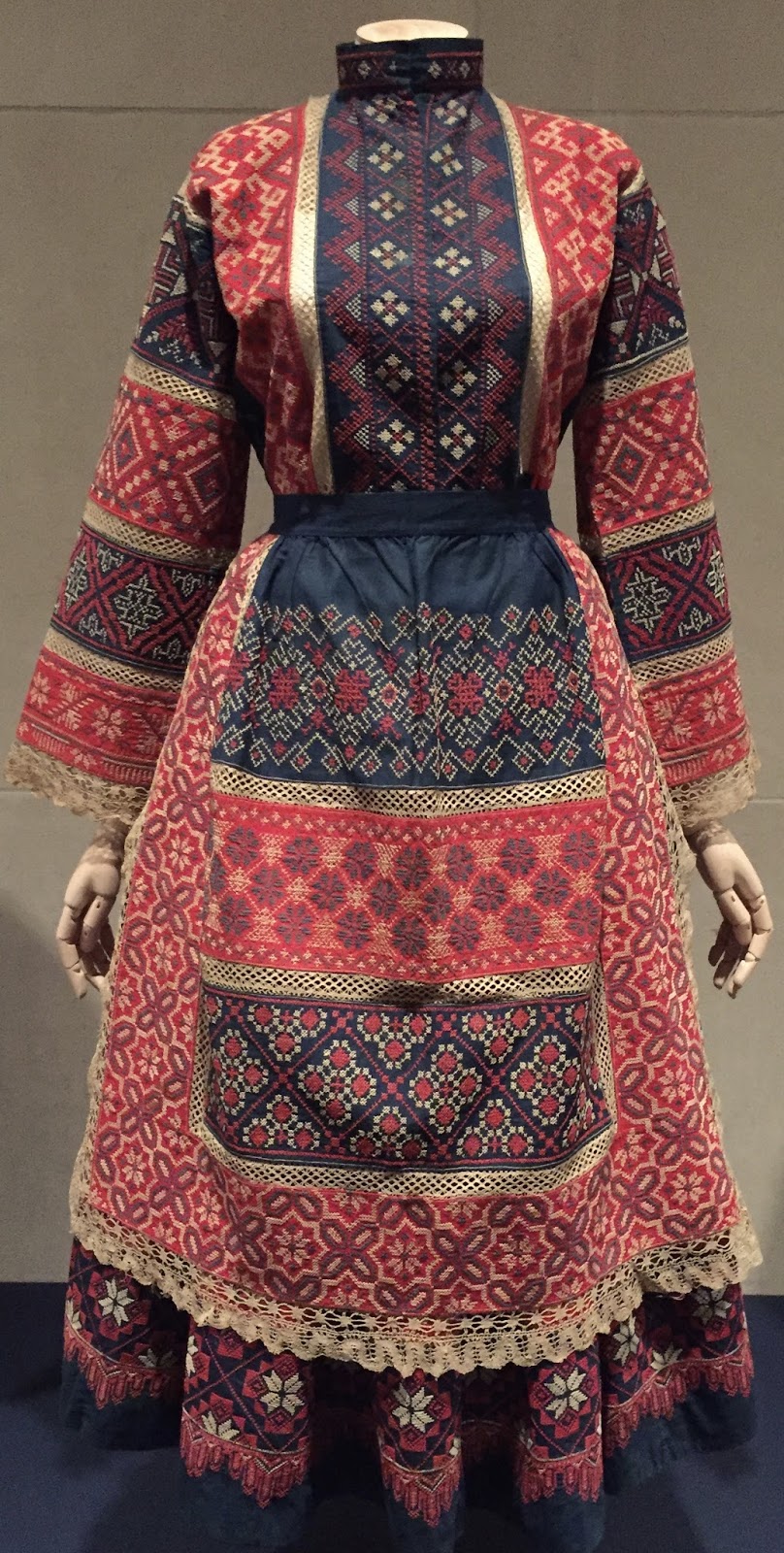
Russian ensemble, embroidery and lace, early 20th C.
American designer Giorgio di Sant'Angelo, 1970
The Metropolitan Museum of Art (MMA) has a significant collection of textile pattern books. These early examples of patterns form the basis for their current exhibit, Fashion and Virtue. Textile Patterns and the Print Revolution, 1520–1620, around which the curators have tied the past to the present.

This show focuses on patterns and specifically on  print patterns that were published to be destroyed. Not malicious destruction, of course, but the patterns were intended for use so the pages were typically torn out and used as patterns for all sorts of textile decoration and embellishment, including embroidery, lace, cutwork, etc. Consequently, not many of these pattern books exist.

It seems to me that exhibits based on books would be a challenge. A book is a unit composed of individual pages. How do you display a page or two to convey the book's value and importance? In this exhibit, the curators displayed the patterns as worked into finished items--garments, accessories, etc.

When I see patterns like this--in books (like Dover's Design Library), on objects and garments of all sorts, and in exhibits like this--I see design opportunities. For example, the print squares with a rose in the centers as well as embroidered design on the smock undergarment on display makes me think of cables. 
Embroidered undergarment,
detail 
Printed pattern
Embroidered Russian ensemble
Early 20th century
One section of the exhibit that I very much liked was one woman's collection of antique handwork fragments. Each piece was mounted with its print pattern and documentation. (I regret that I did not note her name.)

MMA is doing an excellent job of digitizing their collections and making them available online. Click here to view a selection of items in the exhibition.

(PS: The use of 'virtue' in the exhibit's title was an interesting choice. Although needlework was seen as a virtuous endeavor for young ladies after men left the craft to pursue more lucrative jobs, 'virtue' was neither the main theme of the exhibit nor the unifying thread that tied published patterns to the textile patterns.)