Showing posts with label textiles. Show all posts

Thursday, January 7, 2016

Patterns in fashion

Pattern books revolutionize textile art and craft

Antique patterns in traditional and designer garments. 
L-R: Embroidered thobe, Palestinian, early 20th C.
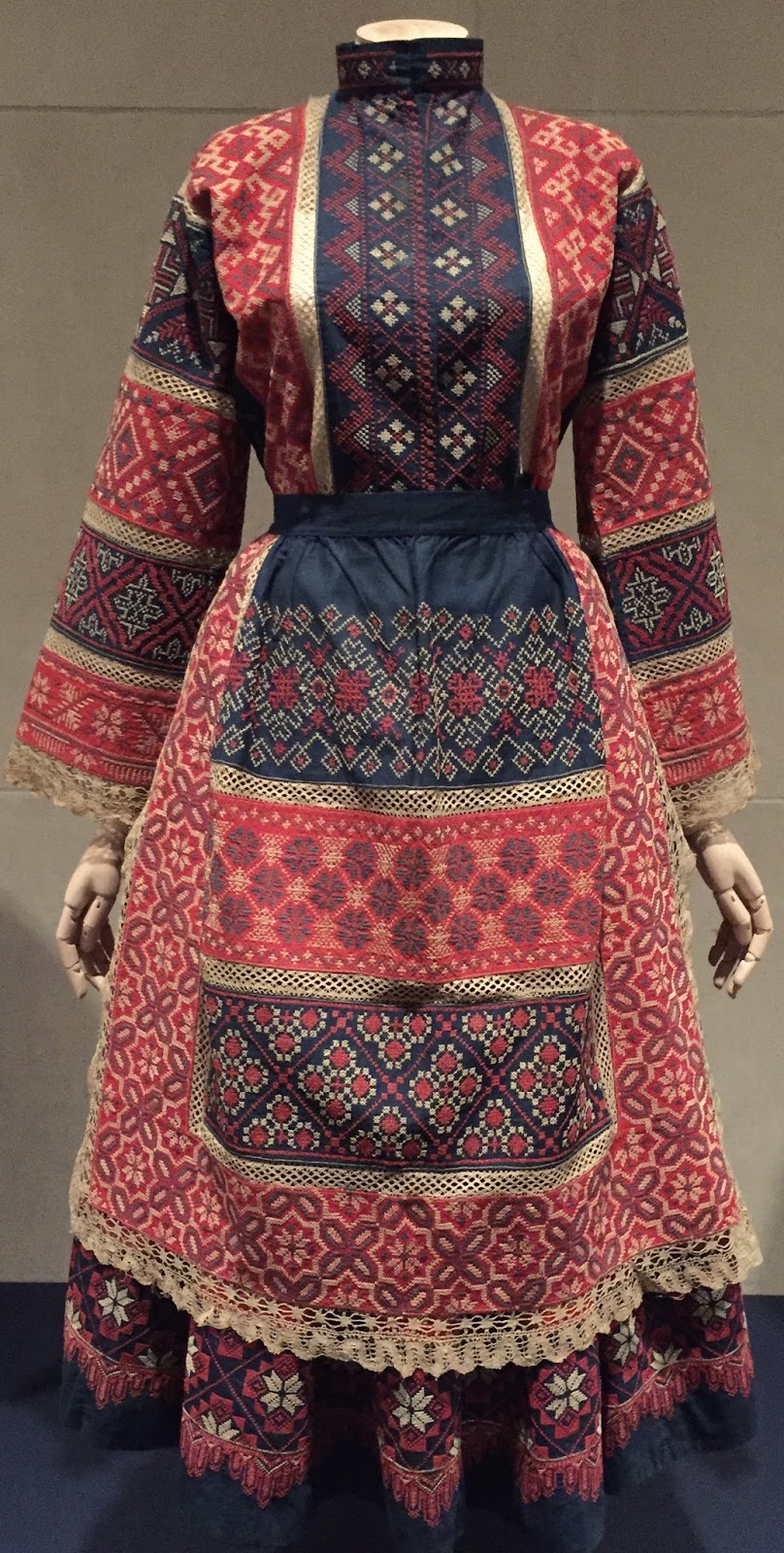
Russian ensemble, embroidery and lace, early 20th C.
American designer Giorgio di Sant'Angelo, 1970
The Metropolitan Museum of Art (MMA) has a significant collection of textile pattern books. These early examples of patterns form the basis for their current exhibit, Fashion and Virtue. Textile Patterns and the Print Revolution, 1520–1620, around which the curators have tied the past to the present.

This show focuses on patterns and specifically on  print patterns that were published to be destroyed. Not malicious destruction, of course, but the patterns were intended for use so the pages were typically torn out and used as patterns for all sorts of textile decoration and embellishment, including embroidery, lace, cutwork, etc. Consequently, not many of these pattern books exist.

It seems to me that exhibits based on books would be a challenge. A book is a unit composed of individual pages. How do you display a page or two to convey the book's value and importance? In this exhibit, the curators displayed the patterns as worked into finished items--garments, accessories, etc.

When I see patterns like this--in books (like Dover's Design Library), on objects and garments of all sorts, and in exhibits like this--I see design opportunities. For example, the print squares with a rose in the centers as well as embroidered design on the smock undergarment on display makes me think of cables. 
Embroidered undergarment,
detail 
Printed pattern
Embroidered Russian ensemble
Early 20th century
One section of the exhibit that I very much liked was one woman's collection of antique handwork fragments. Each piece was mounted with its print pattern and documentation. (I regret that I did not note her name.)

MMA is doing an excellent job of digitizing their collections and making them available online. Click here to view a selection of items in the exhibition.

(PS: The use of 'virtue' in the exhibit's title was an interesting choice. Although needlework was seen as a virtuous endeavor for young ladies after men left the craft to pursue more lucrative jobs, 'virtue' was neither the main theme of the exhibit nor the unifying thread that tied published patterns to the textile patterns.)

Thursday, December 3, 2015

Sights and sounds

Where textiles were hiding in plain sight

Puchari. Jill and Sheldon Bonovitz Collection
I didn't expect to find textiles on the walls at the Curtis Institute of Music, but there they were. Beautiful. And I hadn't even noticed them when entering the recital hall.

A fit of coughing caused me to miss the last performer and the encore of the  Opera Philadelphia recital, but the near empty reception area gave me space to notice the pulcharis. First one. Then more!

The large rectangular wall hangings are from the Jill and Sheldon Bonovitz Collection. Embroidered in rich, vibrant colors the pulcharis are unique to the Punjab and worked in a technique also known as pulchari, or flowering work. The stitched designs represent good fortune, health and happiness, according to the information signage accompanying the works.

Worked from the back in brightly dyed, untwisted silk floss, pulcharis feature floral and geometric patterns and were made during the 19th century and well into the 20th by Punjabi women of all backgrounds and religions. 

According to information posted with the pulcharis, they were commonly worn as head coverings by the women for special rituals and events. (The Minneapolis Museum of Art has a particularly beautiful 19th century pulchari veil made of camel hair and gold thread.) Also, some pulcharis were made to celebrate a special occasion, such as a marriage or a birth. And others were made for temple offerings or ritual wall hangings or canopies.

In the Punjab, women began stitching for a woman's trousseau--for a girl--or as a gift to the groom's parents for a boy. Folk songs and stories record that dreams and desires of the woman were stitched into the pulcharis, which may account for subtle changes in the work throughout the time it was being crafted.

It was a treat to stumble upon this group of generously shared pulcharis. And it was a reminder for vigilance. Beauty surrounds us, if only we take the time to look.
Puchari. Jill and Sheldon Bonovitz Collection

Thursday, June 18, 2015

Knitwear--from under- to outer-wear

Pringle Women's Runway Collection
Look 11. Autumn/Winter 2015

Pringle's retrospective celebrates 200 years of knitwear

I now know that I missed many must-see's on Scotland's Textile Trail, but have no regrets. With fewer than 24 hours to plan a 10-day trip that did not rely on a car, we hit a lot to textile highlights. The exhibit celebrating Pringle of Scotland's 200th anniversary was one of them.

Perhaps best known for its cashmere sweaters, twinsets and Argyle sweaters, Pringle of Scotland has been a fashion icon for years. 

Conveniently located near the Scottish galleries at the the National Museum of Scotland, the exhibit covers a lot of time and progress in a small space. The location is appropriate as Scotland is recognized as the historic birthplace of the knitwear industry. And Pringle of Scotland, which was established in the Scottish Borders, is one of the oldest fashion brands. 


From underwear to outerwear

As undergarments progress from 'peeking out' to becoming outer garments in their own right--think, bustiers, camisoles, and lacy slips, to name a few--who would have guessed that the transition began more than 100 years ago?

The exhibition, Fully Fashioned: The Pringle of Scotland Story, is well done. Now known as a luxury brand, its beginnings were, well, rather stodgy. Practical, yes. Fashionable, no.

Pringle underwear and blocking form
The company's roots are in underwear and hosiery. Surely that was good business in Scotland where the cold is ever near, even in July. But a business like Pringle's doesn't survive for 200 years without change. And Pringle has definitely changed. 

The exhibit brings together a collection of representative knitwear samples over the company's 200 years. Most were from knitwear collections, but in at least one case, the women's golf sweater, the item was "reknit" based on surviving photographs of women golfers in the 1920's.

A walk through the exhibit takes the viewer through not only changes in fashion, but some of the challenges the company faced in the fashion business as it evolved--and sometimes struggled to remain a highly regarded luxury brand. 

A contemporary high-fashion knit coat from Autumn/Winter 2015 runway collection (top, right) sets the stage for the exhibit. It is a dramatic statement that says, 'Look at us now.' Across the aisle, the knit long johns humbly say, 'And this is where we started.' (Alongside the underwear is a blocking form used to shape the garments. Surely the  outsize shape in the thigh area was related to comfort, but I can't help envisioning a disproportional woman with really big thighs and tiny ankles.)


100 years on the outside

Pringle Snug Coat (L), 1940's
According to the exhibit's timeline, Pringle first introduced knitted garments as outerwear in 1905. An accompanying illustration shows a short, close fitting, waist-hugging sweater with front buttons and decorative yoke. The company added silk stockings in 1927--a fashion statement at the time. 

Historical knitwear garments really begin with a 1940's Snug Coat that shows its underwear roots not only it its color, but also in its shaping, its tightly ribbed waistline and the deep ribbing of the lower section (at right). (It doesn't quite live up to my idea of a 'coat.' I'd be more likely to call it  a heavy sweater.) 

And beside it, the classic round-neck button front cardigan (above right). In 40 years, the sweater has gained ease and length. Who would call this vintage?

By the mid-1950's, Pringle had become media savvy. The company used Hollywood actresses as models promote their products. They also invested in top-name designers, updated their look and their promotions. My husband fondly recalls how much he yearned for a Pringle sweater in his college years. He never owned one, but the time aligns with Pringle's promotions and the introduction of its men's Ryder Cup golf shirt.

I was impressed that the company opened a nursery in the mid-1960's to enable more skilled women to work there. (Do they still have a nursery onsite, I wonder?)

Contemporary garments include high fashion garments, as well as classics. Most knitters I know would drool over the hand knit Look 11 in their Women's Runway Collection of Autumn/Winter 2015 collection shown in the top right photo. And then they'd try to figure out how to knit it.

The exhibit runs at the National Museum of Scotland in Edinburgh until August 16, 2015 and is definitely worth a visit. And if you can't make it, check out the museum's slideshow here.

Pringle of Scotland's 20th c. classics--the twinset and the argyle sweater

Thursday, June 11, 2015

Afternoon at the museum

Celtic brooch

Inspiration and awe

On our last full day in Scotland, we returned to Edinburgh and spent the afternoon at the National Museum of Scotland. With limited time, we restricted our visit to the Scottish History and Archaeology wing. With a museum guide, time from the Palaeolithic era to the present day was compressed to fewer than two hours. 

The museum is exceedingly well laid-out and the artifacts, well-displayed. We lingered after the guided tour that compressed the time from the Palaeolithic era to the present day into fewer than two hours. 

I especially treasure museum visits as they almost always provide sources of inspiration. It may be color, line, texture, design--I never know what it will be. But I know that it is almost always there. I just need to slow down and drink in what surrounds me. 

Old designs, modern form and function

Iron Age gold torc
There is a beautiful display of jewelry made by the Early People, so named because they left no written history and little is known about them. Among my favorites were the recently discovered Iron Age gold neck ornaments (torcs) (left) and the Celtic brooch pin (above right).

The torc is spectacular and its design, timeless. The museum obviously thinks so, too. The gift shop has beautiful replicas for sale. 


Woven willow wool basket


I also especially liked the woven willow wool basket, made on the Isle of Skye. Functional and beautiful. And perfect for storing wool to be spun. 

(I keep trying to maintain some focus, but just maybe I do need to try my hand at basketry, after all.)

Industrial archeology

Jacquard loom cards
We also spent a lot of time in the galleries of historic textile equipment. All the machines I have heard of were there--and more. Many are original, but some are scaled down models of the originals. It is quite an impressive collection.


There is a loom like the one at the Weaver's Cottage and there is a Jacquard loom, a mechanical loom that enabled weavers to produce complex patterns such as brocades and damask--and those for paisley shawls. The loom is controlled by a series of punched cards, which are laced together in a continuous sequence. Don't they remind you of early computer punch cards? 

A young Chinese-American couple was also visiting. He works in the textile import business and showed us a photo of the machine in his factory in China that produces textiles. It was nearly identical to the Jacquard loom in the display.

I was also drawn to the beetling engine, mostly because I'd never heard of such a thing. The huge machine was used to soften linen thread and also to add the 'glaze' finish on quality woven linens. Note the hooks for holding--and twisting--linen threads on the bottom left. I can only imagine the noise it would make pounding the material. 
Beetling engine
The museum is a must-see for anyone interested--even a little bit--in Scotland, its history and its people. 

Tuesday, March 17, 2015

Stylish and functional: The lowly handkerchief

Butterfly handkerchief detail. Photo by Maurice Marietti
Handworked items, especially those used every day, hold a special place in my heart. They stir memories of times past and of the people who worked them.

Among the textiles I've saved over the years are nine handworked handkerchiefs, all family pieces. I look at them and memories of my grandmother and great-grandmother flood back to me. 

Handkerchiefs like these were everyday items. Any lady with a sense of propriety carried one and the more beautiful, the better. Although practical necessities, they were also social signals, conveying not only the lady's needle skills but her status.

This was before Kleenex, which was introduced in 1924. I surely have these as my grandmother thought I should carry one, but I never did. However, I certainly remember those who did. The last wave belonged to my grandmother's era, who was born 1899. I estimate the end of the practice to then end of WWII--and the early 1950's at the latest. At least in Ohio.

Cotton 'blanks' were widely available. In my town, the five-and-dime stores--Woolworth's and Kresge's--offered these squares of finely woven cotton, which were hemmed on the edges. They came in various qualities and some featured machine embroidery in one corner. The handkerchief second from the left on the bottom row in the lower photo is an example. 

The crocheted 'Butterfly' hankie, at top right, was surely a showstopper when pulled out of any lady's purse. Although the edging on three sides is simple, the insertion of the butterfly demonstrates much more skill. The 'blank' hankie was cut to the shape of the upper butterfly wings, machine hemmed and finished with single crochet. Lastly, the butterfly, which had been worked separately, was sewn on.


Handkerchiefs with crochet, tatted, and hairpin lace. c.1940-50's
The oldest hankie is the tan one on the top row, far right. It was made by my great-grandmother, who was born in 1874. I barely remember her, but I remember her house and that she was nearly blind. Even so, she kept crocheting. The edging is simple so I suspect this was done later in her life, likely in the 1940's or early 1950's.

The other hankies were made by my grandmother. Her art form was crochet, but not the shortcut form that uses a big hook. She created delicate, beautiful edgings and small items. One of the most beautiful things I recall her making was a delicate, crocheted shawl. (Unfortunately, I don't know what happened to it.) Four of the hankies shown demonstrate her crochet skills. (The blue-and-white second from the right, top row, and the three on the left, bottom row.)

My grandmother was also skilled at tatting (the blue, bottom right) and hairpin lace (the two at top left: the white with pink-and-white edging and the yellow with yellow-and-white edging.)

I don't  ever recall seeing her knit. I sort of remember that she could knit, but preferred the crochet hook. Fortunately for me, she was a patient teacher--and my needlework mentor. As a young girl, she taught me to crochet, tat, as well as hairpin lace and its bigger brother, broomstick lace. I remember crocheting a red bucket-style purse with a round bottom and a gathered closure. It must have been 'beautiful'--as such self-made creations are to 10-year-olds--but I have no regrets that is not among my textile treasures.


Wednesday, February 25, 2015

The pleasure of threads

In NYC last week for lunch, I took advantage of my recently retired status to spend an afternoon appreciating textiles. 

The Japan Week exhibit at Grand Central Terminal was a bonus. I hadn't expected it. But sometimes, those are the most fun. One popular offering was the guy dressed up as a samurai. Lots of people wanted to take advantage of the opportunity to dress up in a shorthand edition of the armor and stand for a photo with the fully-attired actor (at right). Lots of braids on both outfits. Traditionally, the suits were tied together with kumihimo braids hand braided of silk by guilds, which guarded their traditions and skills almost to the death of the braiding techniques.

Next stop was the Fashion Institute of Technology Museum for a some costuming inspiration. 

Faking It: Originals, Copies, and Counterfeits, an exhibit of about 100 objects from the museum's collection, explores the world of original designs vs. licensed copies vs. imitations. As one of the museum's video announcers says, 'you can't copyright color or shape' so it's very difficult to prosecute counterfeiters. In many cases, it's very difficult to tell the difference between the original design and a knock-off. And it's getting harder all the time.

The exhibit's entry features two suits--one a 1966 original day suit by Gabrielle “Coco” Chanel (France), day suit (left) and a licensed copy made in the US in 1967. So what's the difference? According to the information plaque, the differences are in the sewing techniques, the lining and the waistband.

Even more interesting to me than the side-by-side originals and copies, was considering the pieces as design possibilities. For example, the late 18th century Jean-Baptiste Huet original L'Hommage de L'Amerique a la France, at right, has a stunning little bolero-type jacket, but check out the free-standing lace on the sleeve's underside seam.

'Massclusivity'

Two Missoni dresses illustrate the 'massclusivity' trend in which high-end designers partner with mass-market retailers to extend their name and styles downstream. The 2003 Italian-made version is displayed next to a dress that was part of a 400-piece limited edition collaboration between Missoni and Target in 2011. The 'look' is certainly similar, but the fabrics and knitting techniques distinguish the high quality original.


The other exhibit, Yves Saint Laurent + Halston: Fashioning The ’70s, was nostalgic. Their names alone conjures up images of the era's styles. Cleaner, crisper lines, for one. The exhibit focuses on shared themes, one of which was the influence of menswear on women's fashion.

Faking It: Originals, Copies, and Counterfeits is on view through April 25, 2015.
Yves Saint Laurent + Halston: Fashioning The ’70s is on view through April 18, 2015.