Showing posts with label fashion. Show all posts

Friday, October 27, 2017

Who is not inspired by nature?


Nature is an endless source of inspiration

For hundreds, if not thousands of years, nature has been a source of inspiration for artists and designers. Leonardo da Vinci is to have said, “Those who are inspired by a model other than nature, a mistress above all masters, are laboring in vain.” 


Nature has always been a deep source of inspiration for me. Last week, I turned to scrapbook of images I've collected over the years for use in color and sensibility inspiration. Not all, but many, many are nature shots. Colors. Textures. Lines. It's all there.

L: Natural Dis-Tinction, Un-Natural Selection.
Spring 2009 collection. R. Plato's Atlantis dress, 2010. 
Alexander McQueen.
So when I saw "The Force of Nature" theme of the current exhibit at The Museum at FIT, I knew I had to get there. The exhibit encompasses a nature-inspired fashion from a wide range of sources--from the more usual plants and animals to ocean life, microorganisms and weather.

When I got home I found that I had three photos of fashion with feathers. All highly dramatic and certain to be the center of attention in any social setting. 

I love the colors and designs of feathers, but I don't need to use them other than as inspiration. I pick up interesting ones and pin them to my 'important' board above my desk. 
Cape and hat, pheasant feathers
Bill Cunningham. 1960s


The two dresses (at right) by Alexander McQueen, known for  his dramatic designs, can be best described in his own words: "I have always loved the mechanics of nature, and to a greater or lesser extent my work is always informed by that." 

The Museum at FIT is on Seventh Avenue at 27th Street in New York City and free to the public. This exhibit runs through Nov. 18, 2017. More information here.


Other quotes on nature's include on art and fashion

FIT's exhibit guide leads with da Vinci's quote, which is widely attributed to him and sounds like something he would have said. Although I have failed to find the source, I found other good quotes, which are highly appropriate and too good not to share.
"No form of Nature is inferior to Art; for the arts merely imitate natural forms." Marcus Aurelius 
"To the artist there is never anything ugly in nature." Auguste Rodin
And then there is this witty--and withering--assessment of fashion:
"Change in fashion is the tax which the industry of the poor levies on the vanity of the rich." Nicolas Chamfort

Tuesday, October 18, 2016

Extreme views

From the ordinary to the extraordinary

L. Ralph Lauren pantsuit, 2013. R. British mess jackets
The two exhibits currently a the Museum at FIT (Fashion Institute of Technology) in New York couldn't be more different. One focuses on the influence of uniforms--school, sports, military, service industry--on mainstream fashion. The other focuses on one woman's collection of high-end couture fashion.

Both are excellent. And both are free.

Fashion inspired by the ordinary

The Uniformity exhibit, which is in the Fashion & Textile Gallery on the main floor, opens with two  British military "mess dress" jackets c. 1900. The  elaborate braid and soutache patterns, which once served as protection in hand-to-hand combat, continue to inspire contemporary fashion designers. One example is seen below in garments by Yves St. Laurent and Ralph Lauren.
L. Yves St. Laurent, 1967. R. Perry Ellis, 1983

With a focus on four categories of uniforms--military, work, school, and sports--the exhibit provides examples and detailed information to show direct relationships between uniforms and fashion. 

According to signage, Yves Saint Laurent began experimenting with military elements in the mid-60's. Re-appropriating the naval peacoat, his navy blue, double-breasted jacket became one of his signature styles. On a very personal note, his 1967 ensemble (left) is remarkably like the navy blue dress and jacket I made for my going-away suit (remember those?) in.....1967!

Most viewers will be familiar with each and every uniform as well as its vestige in modern interpretation. I think the personal connections make this an engaging show and well worth a visit. 

Uniformity runs through November 19, 2016.


Fashion as unique creations

Distinctly different and on the opposite end of anything derived from lowly uniforms are the extraordinary fashions from the wardrobe of Élisabeth de Caraman-Chimay, the Countess Greffulhe (1860–1952). The exhibit, Proust's Muse: The Countess Greffulhe, is in FIT's Special Exhibitions Gallery. 

Based on a Paris exhibition organized by Olivier Saillard, director of the Palais Galliera, Musée de la Mode de la Ville de Paris, which is the repository of the countess's wardrobe, this exhibit is a collaboration of Saillard and Dr. Valerie Steele, director and chief curator of The Museum at FIT.

Unfortunately, no photos are permitted in the exhibit so you'll have to make a trip to personally drool over the truly spectacular garments.

Proust's Muse: The Countess Greffulhe runs through January 7, 2017.


Can't possibly make it in person? Check out the museum's online virtual tours at Uniformity and Proust's Muse: The Countess Greffulhe.

Tuesday, July 19, 2016

African fabrics and fashion

An example of a Vlisco textile

African fabrics to impress, inspire and surprise

First, the surprise. The wax printed textiles traditionally associated with West and Central Africa aren't manufactured in African at all. Rather, they've been designed and made in Europe for a very long time (and now China and India). 

Currently, five exhibitions at The Philadelphia Museum of Art (PMA) currently has five exhibitions under the umbrella, Creative Africa. Ranging from historial to contemporary, two of the exhibits focus on  fabrics and fashion. 

Vllisco. (de Groot) 2007. 

Dutch fabrics to Africa

The exhibition, Vlisco: African Fashion on a Global Stage, focuses on historical and contemporary textiles from the Dutch company Vlisco. Founded in 1846, the company entered the market in the last quarter of the 19th century--and was the market leader for years. It and continues to influence African fashion in through its its unique fabric designs in 'Dutch wax' fabrics that originate from batik techniques. 

Vlisco textile with scissor design. 
Vlisco doesn't distribute its cloth by design name, allowing African traders who sell it to name the patterns. Such naming practices add a layer of identity, status and value. 

Some designs are drawn from earlier textiles. One example is this swallow design by Marjan de Groot in 2007, an update of a 1949 design by Tonnie Wouda. Both are cotton, wax block prints.

There were shoes, ties, and scissors, to name just a few. Maybe a seamstress would wear the print with scissors?

Traditional textiles

Another gallery showcases the traditional textiles of Central and West African weavers, dyers, and other artisans in the museum's Threads of Tradition exhibit. Strip-weaving, resist dyeing, appliqué, and embroidery provide beautiful colors and patterns.

The colorful man's cloth (above left) was made by the Ewe or Adangme culture, Ghana or Togo c. 1920-1970. According to the label, It is strip-woven cotton warp-faced and balanced plain weave with continuous supplementary wefts and weft-faced rib weave. 

A woman's loincloth or skirt (above right) was particularly fascinating. Made by the Dida culture, Côte d'Ivoire, c. 1900-1950, it is braided of raffia in a tube and stitch-resist dyed--the stitch points can be seen in some sections.


Look Again

Although not focused on textiles, the exhibit "Look Again: Contemporary Perspectives on African Art" is a must-see. This major collaborative exhibition, which is billed as the heart of "Creative Africa," is drawn from the Penn Museum’s world-renowned African collection. Featuring art created in West and Central Africa from the 1500s to the 1900s, the show is impressive.

Wednesday, June 29, 2016

Hands, machines and technology

When fabrics combine hand, machine and technology

Iris van Herpen, 2012. 3-D printed epoxy
If you like the many faces of fabric, get thee to the Met before The Costume Institute's spring 2016 exhibition, Manus x Machina: Fashion in an Age of Technology  closes because it's a stunner.

The show is full of beautiful objects, but its focus is on  how fashion designers have embraced machines and technology to create new works. Almost all designs are  from the early 20th century to the present. The exception is an 1870 Irish crocheted wedding dress.

Ranging from haute couture to prêt-à-porter, some of the works are very avant-garde--and barely wearable. Like the cast fiberglass 'statement' dress that releases maple-seed-like elements by remote control. But the majority of the 170 ensembles are not only very wearable, but elegant and timeless. 
Iris van Herpen dress, 2013-14.

Fabric meets technology

Gareth Pugh, 2015-16.
Dutch designer Iris van Herben's haute couture dresses stand out as examples of harnessed technology--and you don't need to like them to appreciate their creativity. One of her dresses was made of 3-D printed epoxy, sanded and hand-sprayed. 

Another van Herben dress (at left) is strangely dark and highly textured. Its fabrication, fascinating. Cotton twill fabrics was hand-painted with polyurethane resin and iron filings, then hand-sculpted with magnets. 

Another dramatic haute couture dress by British designer Gareth Pugh was machine-sewn white sold-wool gazer with an overlay of white mesh and hand-embroidered with clear plastic drinking straws. Prefer one in black? He has one of those, too.

Alexander McQueen, 2014-15.

Feathers, pleats, lace, leather...and more

I almost had visual overload on the many ways feathers were incorporated into dresses and capes. One Alexander McQueen ensemble (2014-15) is covered with embroidered ostrich and goose feathers. 
Junya Watanabe, cape. 2015-16
And how about pleats? It's hard to outdo Spanish designer Mariano Fortuny for pleats and, yes there are several of his classics to behold. For modern interpretation, I was taken with the contemporary (2015-16) cape of machine-sewn gray wool and polyurethane jersey by Japanese designer Junya Watanabe.
Hussein Chalayan, "Duck dress." 2000.

Scissors are always at hand, but not in the way British designer Hussein Chalayan used them to create his prêt-à-porter "Duck" dress. He cut away shapeless bales of pink tulle fabric by hand until he had a female shape. Kind of like shaping boxwood hedges, I guess.

There is much, much more. If you can't get to the exhibition, consider purchasing the Manus x Machina catalog

And here are a few more dresses that I found particularly stunning.
L-R: Irish crochet wedding dress, 1870. Paul Poiret.Coat-wool, leather. c.1919.
Norman Norell, evening dress. 1965 (prêt-à-porter)
 

L-R: Givenchy, 1963. Dior "Venus, 1949-50. (haute couture)
Alexander McQueen, 2012 (prêt-à-porter)

Thursday, January 7, 2016

Patterns in fashion

Pattern books revolutionize textile art and craft

Antique patterns in traditional and designer garments. 
L-R: Embroidered thobe, Palestinian, early 20th C.
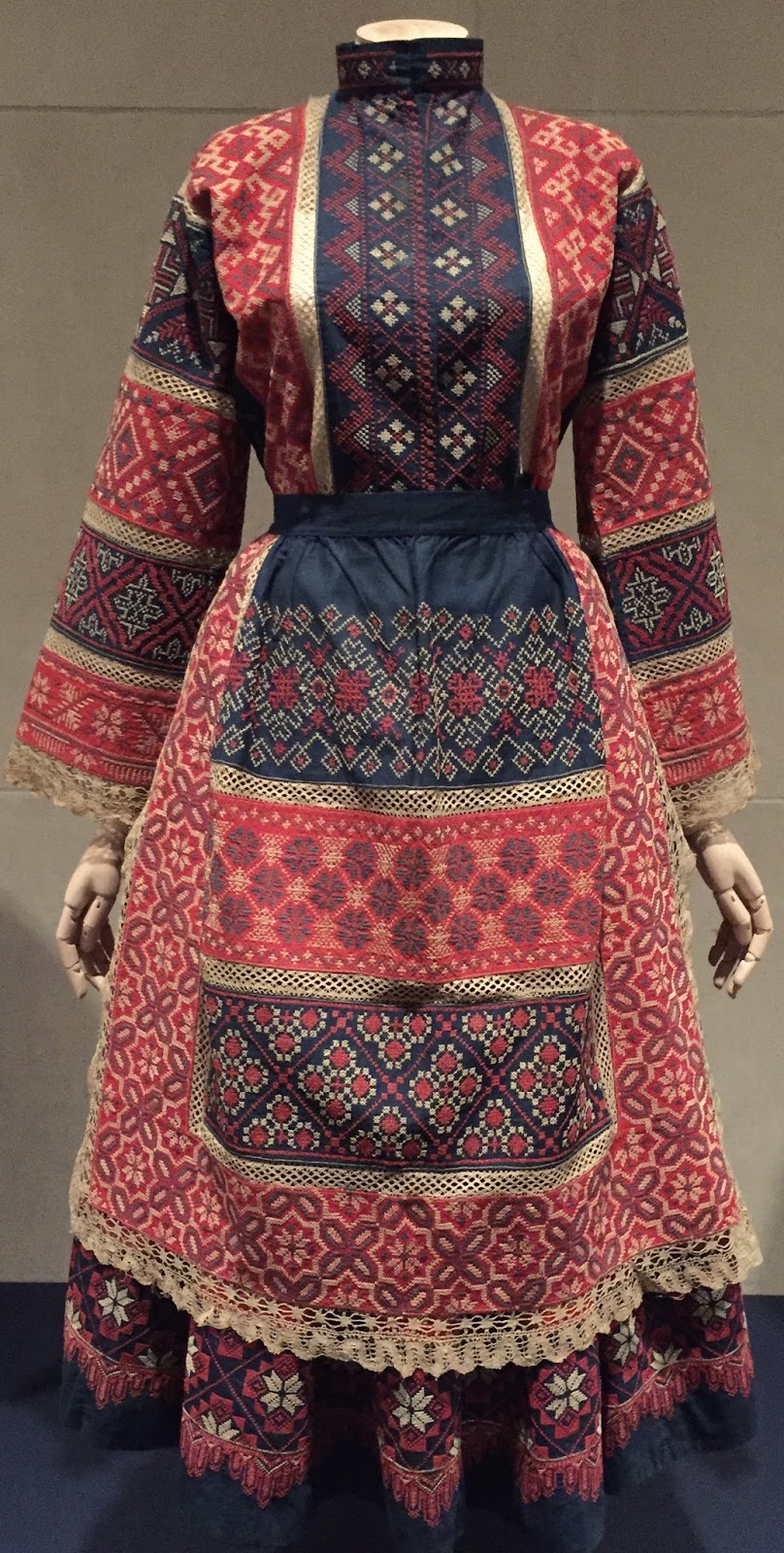
Russian ensemble, embroidery and lace, early 20th C.
American designer Giorgio di Sant'Angelo, 1970
The Metropolitan Museum of Art (MMA) has a significant collection of textile pattern books. These early examples of patterns form the basis for their current exhibit, Fashion and Virtue. Textile Patterns and the Print Revolution, 1520–1620, around which the curators have tied the past to the present.

This show focuses on patterns and specifically on  print patterns that were published to be destroyed. Not malicious destruction, of course, but the patterns were intended for use so the pages were typically torn out and used as patterns for all sorts of textile decoration and embellishment, including embroidery, lace, cutwork, etc. Consequently, not many of these pattern books exist.

It seems to me that exhibits based on books would be a challenge. A book is a unit composed of individual pages. How do you display a page or two to convey the book's value and importance? In this exhibit, the curators displayed the patterns as worked into finished items--garments, accessories, etc.

When I see patterns like this--in books (like Dover's Design Library), on objects and garments of all sorts, and in exhibits like this--I see design opportunities. For example, the print squares with a rose in the centers as well as embroidered design on the smock undergarment on display makes me think of cables. 
Embroidered undergarment,
detail 
Printed pattern
Embroidered Russian ensemble
Early 20th century
One section of the exhibit that I very much liked was one woman's collection of antique handwork fragments. Each piece was mounted with its print pattern and documentation. (I regret that I did not note her name.)

MMA is doing an excellent job of digitizing their collections and making them available online. Click here to view a selection of items in the exhibition.

(PS: The use of 'virtue' in the exhibit's title was an interesting choice. Although needlework was seen as a virtuous endeavor for young ladies after men left the craft to pursue more lucrative jobs, 'virtue' was neither the main theme of the exhibit nor the unifying thread that tied published patterns to the textile patterns.)

Monday, December 21, 2015

Wrapped in luxury

Wear a fur as if it is cloth, and cloth as if it were fur.

Paisley shawl, detail. ca. 1860.
It's an old saying that I have always loved as it speaks to how a woman wears a coat. She wears the coat. The coat does not wear her. 

I have no opposition to fur coats, but I've never wanted one. Perhaps if I lived in a very cold climate, I'd feel differently. But I don't.

This gives me far more latitude (If I had a fur coat, I'd feel obliged to wear it at every opportunity) and allows me the luxury of wearing my personal treasures more often. 

To me, there is little more satisfying than wearing a spectacularly beautiful textile. I appreciate hand crafted textiles, like the poncho from the women's co-op in Inga Pirca, Ecuador where they raise and shear the sheep, spin the wool, weave the fabric and make the garment. Also from Cuenca, Ecuador, I have an irate poncho. There is a beautiful embroidered jacket from Guatemala and a scarf from Japan dyed with cherry blossoms, to name but a few. They are my treasures.


Paisley shawl, ca. 1860.

A spectacular paisley shawl


One particular treasure is my antique paisley shawl. While living in London, I had deeply admired the antique paisley shawls in markets and developed a real love of them in their many forms. Small and large squares and rectangles. I loved them all. But I never bought one. They were very dear.

After returning to the States, we saw a particularly beautiful and pristine shawl at an antique fair. Secretly M. purchased the shawl and gave it to me for Christmas. He also crafted a lovely cedar box in which to store it.

My wool shawl is large--72 inches square--and woven of very fine wool. Sometimes I wonder whether it was purchased here in the U.S. or brought in a trunk. Where was it worn? and what could she tell me? These--and other  stories--are all unseen yet woven into the shawl.

I absolutely love my shawl and wear it whenever the occasion and the weather permits. And when I wear it, I feel special. And why shouldn't I? I'm wrapped in luxury. 


Thursday, November 19, 2015

Fashion, craft and fiber art

Fashions may change, but exquisite craftsmanship endures

Detail, Coral-encrusted evening gown. Givenchy. c.1964.
The current exhibition, Immortal Beauty, at Drexel University in Philadelphia exceeded all expectations. For one, I had no idea Drexel had such depth in textiles and fashion. Its collection documents more than 400 years of costume history and holds more than 14,000 garments and accessories.

From Parisian couture of the late 19th and early 20th centuries through to high fashion from the mid-20th century on, the collection is a serious resource for study. Suggested more than 100 years ago by the then Director of the School of Illustration Howard Pyle, a collection of fashionable dress and accessories would support study by Drexel's dressmaking and millinery students.

The exhibit is only a taste of Drexel's large collection, but it is a sweet one. 
Melanie Pascal
dinner dress, c. 1878.


Beginning with 19th century fabrics and garments (and one 16th C textile fragment), the exhibit travels in time into the early 21st century. Garments are complemented by accessories--hats, shoes, handbags and a spectacular parasol--and represent designs by leading designers of their day. The big names are there--Charles Frederick Worth, Mariano Fortuny, Givenchy, Salvatore Ferragamo, Christian Dior, 'Coco' Chanel, Mary Quant, Halston--and many more.

I loved the lacework on the Melanie Pascal dinner dress. Its not likely to find such rich lace these days, but the lines suggest other textural applications in knitting or weaving.

Givenchy evening gown.
c.1964

But the star of the show is an evening gown richly encrusted with coral branches and embroidery. Donated by Her Serene Highness Princess Grace of Monaco, who is known to have worn the dress at least three times. The descriptive video near the end of the exhibit includes footage of her in the gown. The gown, which weighs 15 pounds, is stunning, to say the least. 

I also loved the the evening gown, c. 1926, by Callot Sours. Even on a mannequin, the dress seems likely to shimmy off its mannequin. And perhaps the original owner had a mesh purse, c.1928 like the one made by Whiting & Davis on display. (Both below) Spectacular.


Whiting & Davis mesh purse,
c.1928
The exhibit is free and open through December 12. If you like and are inspired by costume and fashion, try to fit it into your schedule. 
Callot Soeurs evening gown,
c.1926.

Thursday, August 6, 2015

Got rust?

Rust not only dyes, it can create unique patterns on fabric

Anita Luvera Mayer
Just ask Anita Luvera Mayer. In her MAFA 2015 workshop, she taught students a range of dyeing and embellishment techniques. One focused on the use of rust and black tea to dye and design fabric.

I came close to taking her workshop, which was entitled, "Don't Change the Sheets, Change the Cloth." It sounded fun. And that's exactly what one of the participants told me when I asked about her weekend experience. "It was fun!" she exclaimed.

Anita is a fiber artist, author, and mentor, but above all that, she is an inspiration to others not only for her creativity and expertise, but for her passion for life. "Live now!' she urges, explaining the essence of her approach to life like this:
"I believe that if a person has a passion for any activity, they will have a full and exciting life. Do not wait to "follow your bliss." Celebrate the moment and day and take time to do what you love. This sometimes means making hard choices and saying no, but if you are clear as to your priorities, this is essential. 
"My priorities for years have been and are: myself, my creative time, my family-- and in that order, because if I do not take care of my health and my need to create, I have little left to give to the people I love. Live now!"
She swept through MAFA 2015's weekend retreat like a queen and charmed us all. She's tall and slim with a model's posture and bearing. Almost anything looks great on her. She wowed the audience at the Fashion Show as she modeled a striking white top. A professional model couldn't have shown it off better.
Student scarves dyed w/rust and tea

Then, when visiting her workshop the next evening for  Open Studio, we found ourselves entranced with her  enthusiasm and genuine love of sharing her craft and her passion.

Anita is a teacher in her heart and in her bones. She is also extremely organized. For example, her students leave with a  reference notebook of instructions and samples. 'How many times do you leave a workshop and can't remember exactly what you did or how you did it?' she asked rhetorically. The notebook solves that problem.

There is much to admire about Anita, but I am most impressed with her proud and unapologetic acceptance of who she is--a mature woman who knows and accepts herself. Not content to sit on the sidelines, she accepts her age, but is not defined by it. She celebrates her age as she celebrates life. 
"I celebrate my age of 82," she says. "Age is only numbers and I have places to go and garments to make so I have no intention to retire." Anita Luvera Mayer

Looms in the living room

Rust-dyed jacket, Anita Luvera Mayer
Anita credits her start in weaving to a wedding gift from her mother-in-law. A  well-respected Seattle weaver, Marcelle Mayer gave each of her three daughter-in-laws a 36 inch floor loom and weaving lessons. Although most daughter-in-laws would likely find this a rather presumptuous gift, Anita subsequently dedicated her first book, "Clothing from the Hands That Weave," to Marcelle Mayer for raising a son who thought looms in the living room were perfectly normal. (Isn't it?) 

As Anita says, "My moment of truth regarding my passion for clothing was the result of a two hour seminar at the first Convergence in 1972 in Detroit, Michigan. Ros Berlin, presented a program on clothing and I knew immediately where I was going with my weaving and wrote in my journal that night, June 1972, "from this day forward any major piece of clothing I wear I will make.""

And she proceeded to do just that. Known for her clothing that requires little to no shaping in construction, she explains, "I "discovered" modular clothing--or actually clothing from simple rectangles and squares--because I did not know how to tailor handwoven fabric." That simple. And yet, not simple at all. 


Inspiration, creativity and life experiences

it is easy to see the connection between Anita's work and the designs of ethnic cultures. She is inspired by their clothing and the creativity of women who work to adorn their bodies and clothe their families. She says, "My work always speaks, in some way, to these cultures either in the color, embellishment,  or shape." 

Her sources of inspiration have remained much the same over the years, but her work has matured, much as her interests have evolved and she has matured as an artist. "I have created clothing that speaks to my love for the sunsets and sunrises. Then, as I got older, all my work was about honoring women with each garment speaking to age, wisdom, loss and love--all that I experienced living my life," she says.

Her current body of work continues to be inspired by clothing and textiles of other cultures, but she has been working more with interesting techniques in creating the cloth. This interest was readily apparent in her workshop at MAFA 2015.

She has met her 1972 goal--and then some. In addition to creating interesting pieces to her personal wardrobe, she has inspired many, many others to not only have fun in the process of creativity, but to celebrate themselves as individuals. 
"My goal from 1972 to 2015 has been to "wear on the outside who I am on the inside and do honor to my individuality by what I make and weave." Anita Luvera Mayer

Teaching to the tribe

Purple jacket. Anita Luvera Mayer
Teaching is exhilarating but it is not for the faint-hearted. Mastery of a particular skill and the desire to share knowledge are not enough. Anita is one of the select and gifted few who are natural teachers, so I asked her to share her  words of wisdom for fiber artists who teach--or would like to teach. Here's what she says:
"My goal in teaching is to help women find their own self-esteem and to honor who they are by the the clothes they wear.  
"Every time I teach, I come home with new ideas and questions but mostly my passion for teaching is that I so respect and enjoy the women who are involved in fiber. They are "my tribe" and I want to be with them.
"If you love what you do and want to share that love, put together a workshop and submit it to conferences and guilds. I wrote articles, did "free" lectures, kept applying to conferences even though I was turned down many times."
Anita Luvera Mayer wants to make it clear: She has absolutely no intentions to retire. She remains eager to do lectures and workshops for guilds. Invite me and pay me, she told us, and I'll be there. 

Conferences are on another scale, however, and Anita foresees a fitting end to her leadership role in conference workshops. The plan is to end where she began--with the Association of Northwest Weavers at their 2017 Conference, Treadle Lightly, in Victoria, B.C. It was the first conference she attended wearing her distinctive handwoven clothing. 

I, for one, can't wait to see what she'll be wearing to that event!

Wednesday, February 25, 2015

The pleasure of threads

In NYC last week for lunch, I took advantage of my recently retired status to spend an afternoon appreciating textiles. 

The Japan Week exhibit at Grand Central Terminal was a bonus. I hadn't expected it. But sometimes, those are the most fun. One popular offering was the guy dressed up as a samurai. Lots of people wanted to take advantage of the opportunity to dress up in a shorthand edition of the armor and stand for a photo with the fully-attired actor (at right). Lots of braids on both outfits. Traditionally, the suits were tied together with kumihimo braids hand braided of silk by guilds, which guarded their traditions and skills almost to the death of the braiding techniques.

Next stop was the Fashion Institute of Technology Museum for a some costuming inspiration. 

Faking It: Originals, Copies, and Counterfeits, an exhibit of about 100 objects from the museum's collection, explores the world of original designs vs. licensed copies vs. imitations. As one of the museum's video announcers says, 'you can't copyright color or shape' so it's very difficult to prosecute counterfeiters. In many cases, it's very difficult to tell the difference between the original design and a knock-off. And it's getting harder all the time.

The exhibit's entry features two suits--one a 1966 original day suit by Gabrielle “Coco” Chanel (France), day suit (left) and a licensed copy made in the US in 1967. So what's the difference? According to the information plaque, the differences are in the sewing techniques, the lining and the waistband.

Even more interesting to me than the side-by-side originals and copies, was considering the pieces as design possibilities. For example, the late 18th century Jean-Baptiste Huet original L'Hommage de L'Amerique a la France, at right, has a stunning little bolero-type jacket, but check out the free-standing lace on the sleeve's underside seam.

'Massclusivity'

Two Missoni dresses illustrate the 'massclusivity' trend in which high-end designers partner with mass-market retailers to extend their name and styles downstream. The 2003 Italian-made version is displayed next to a dress that was part of a 400-piece limited edition collaboration between Missoni and Target in 2011. The 'look' is certainly similar, but the fabrics and knitting techniques distinguish the high quality original.


The other exhibit, Yves Saint Laurent + Halston: Fashioning The ’70s, was nostalgic. Their names alone conjures up images of the era's styles. Cleaner, crisper lines, for one. The exhibit focuses on shared themes, one of which was the influence of menswear on women's fashion.

Faking It: Originals, Copies, and Counterfeits is on view through April 25, 2015.
Yves Saint Laurent + Halston: Fashioning The ’70s is on view through April 18, 2015.