Wednesday, April 20, 2016

Fiber to fabric

Natural and dyed felted eye candy

Interlocked threads transform to beautiful fabric

With a pile of roving in hand, why not needle felt it to make fabric? After our test drive on the felting machine, it was time for some production felting.

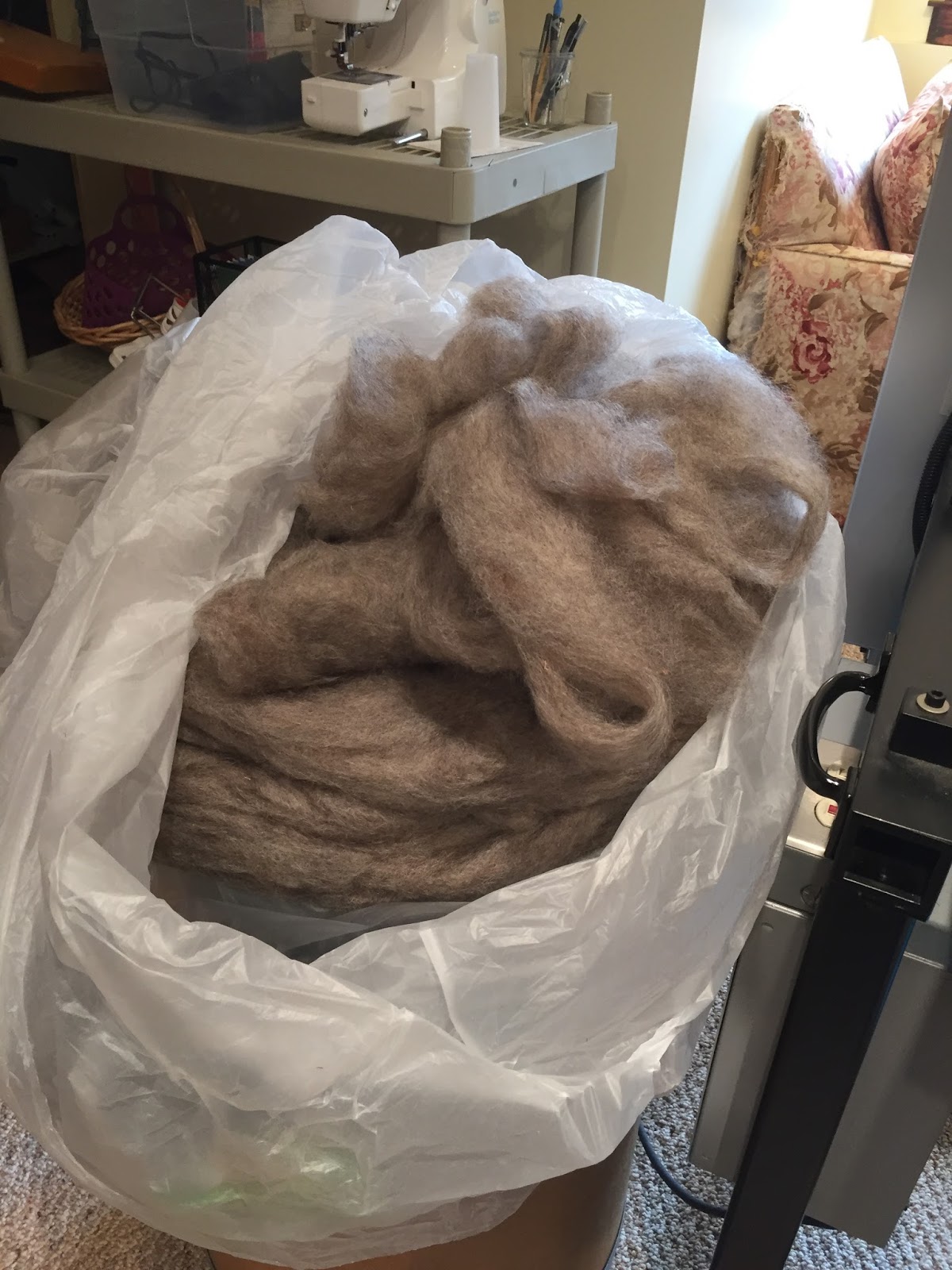
As we would be renting the felting machine at an hourly rate, the plan was to prepare as much as possible at home and take them ready to feed into the machine. Using Coopworth roving, we cross-hatched roving to form what I'm calling pseudo-batts. 
Layered roving prepped and ready to feed


We had 11 of these batts in total and transported them without a hitch. Most of them were large and naturally colored pieces. Three used colored roving. 

Getting the batts onto the bed of the felter sometimes required more than four hands, but, like the prep, it took doing it to figure out the best way to do it. Overall, they turned out exceedingly well and we're pleased with the results. 

Or, I should say, Kris is pleased. They're from her flock and  will be for sale at the upcoming Maryland Sheep & Wool Festival. She'll be at the American Coopworth Registry booth, a shepherds' co-op, in the auction tent area.
Blue-green felt comes off the machine


But just because they're not mine doesn't stop me from thinking about what might I do with these pieces of felted wool. I can see embellishment--embroidery, felting, etc.--on the colored pieces, or maybe a hat. and the one with stripes? A hat. 

As for the bigger pieces, I see vests and sweaters--maybe with knitted sleeves. Paint them to add color. Or not.

These are all blank slates ready for the creative fiber artist 


Tuesday, April 12, 2016

Pinelands Spring

Pinelands Spring cowl

Spin, span, spun....and beyond

After a long hiatus, I have regained some control over my knitting machine. Fortunately, I had kept it in a good location and it only needed a good cleaning. Not even a deep cleaning, which would have required disassembling the beast. Now it is performing well--at least as well as my skills can oversee. 

I acquired my machine during my time in London when I was doing my City and Guilds course. But once back in the States, I knit with it very little. Now, with a number of knit 'works-in-progress,' I am faced with the same dilemma as long ago. That is, lots of ideas and not enough time to execute even a fraction of them.

I continue to be surprised at the attitude of most knitters to machine knitting, who, by and large, look down upon any automation. For heaven's sake, the items don't knit themselves! Each project requires the same amount of planning and attention to detail as a handknit. Only the process may be faster. I say 'may' because there can be a great deal of time-sucking manipulation of stitches and manual work involved.


Getting my groove back

I started at the beginning on the knitting machine, relearning to cast on stitches. Then I knit samples. I knit lots of samples.

I have two near-term objectives. One is to knit sleeves for coat-weight handwoven fabric. I don't have enough yarn for the sleeves, so I'm now planning colorways and suitable knit fabrics that will complement, but not compete with, the coat.


Artful Color, Mindful Knits
by Laura Bryant
The other project is a jacket that I saw at Vogue Knitting Live in New York earlier this year. Designed and worn by speaker Laura Bryant, I particularly liked the pattern drape and design. It's on the cover--and in--her book,  Artful Color Mindful Knits, so promptly ordered on my return home. The key, she told the group, was the shaped arms and the collar. The body pieces are just rectangles--perfect for the machine.

I want to make a similar jacket, but the project won't be a small one. I'll need to dye yarn to achieve the color magic. (Note: This book is a wealth of information on working with hand-dyed yarns.) 

But before I embark on such a project, I need to know if I'll like the jacket design because it has dropped sleeves--and I generally HATE dropped-sleeve designs.) So today, I plan to do gauge samples, decide what stitch pattern I'll use and knit up the pieces. Only then will I know if I like it or not.
Pinelands Spring, stitch detail


What's done can be yours

Last week, I shared with you my journey spinning for knitting. And although I shared a photo of my first project off the machine, I didn't give a lot of detail. It was based on a stitch sample I had knit and some handspun Merino singles. I had 3.9 oz. of yarn, 16 wpi. 

It was my first foray spinning  Merino and it wasn't as evenly spun as I'd have liked, but as you can see in the detail at right, it doesn't stand out, thanks to the textured rib pattern. 


Pinelands Spring cowl
Pinelands Spring cowl was the project and, because I like it....a lot...I wrote out the pattern and posted it on Ravelry as a free download. It's perfect for handspun--even less-than-perfectly-spun handspun. 

And if you don't have a machine, but like the textured rib, maybe you can play around with a handknit rib that achieves an equally interesting texture. Time to play!

Monday, April 4, 2016

Spinning to knit

Pinelands Spring cowl
Yarn: single ply handspun Merino

I have a basket full of handspun. Now what?

Last year, I had bags of roving piled in my studio. This year, the bags had been transformed into yarn. I am pretty much happy with the yarn, but the more I spun, the more satisfied I became. 

Over the years, I have spent far too much time dwelling on my frustration in spinning larger gauge yarns. As I was sharing this with other spinners, the reality hit me: I prefer to work with finer gauge yarns. Why do I need to spin larger gauge yarn? I don't. 
Yarn being wound from the bobbin

So after freeing myself from 'should do's,' I have moved on to focus on spinning fine to medium yarns for consistency. Should I get bored, I can add any number of challenges by spinning wool from different breeds. 


Consider the breed

Winter's Past Farm raises Coopworth sheep and I can't say enough good things about spinning their fleece. At the top of the list is 'easy to spin.' I also like the color, which accepts dye easily. I had some Tunis and found spinning that about the same as the Coopworth. Then I moved on to the Dorset, a down wool, and Merino, a fine wool, both with shorter staple lengths.

Then Romney, which I was gifted at the local guild's Rock Day celebration. Easy to spin but for one major negative totally attributable to the shearer. It was riddled with second cuts--short lengths of wool from the shearer's second pass on the sheep. The short fibers form noils, which defeat smooth, even yarns and are the very devil to pick out when spinning. 
Counting as I wind on

This year's focus was on spinning singles suitable for knitting. That meant taming the twist as much as possible. With this goal, I've been spinning these with a short draw with my wheel ratio set as slow as possible. 

My first project through to completion was Pinelands Spring  cowl knit with Merino singles on a knitting machine. The pattern itself adds an exaggerated stitch in the rib variation, which in itself adds texture but doesn't draw attention to any inconsistencies in the yarn. (If you like the pattern, it's available as a free download on Ravelry.)


Spinning data

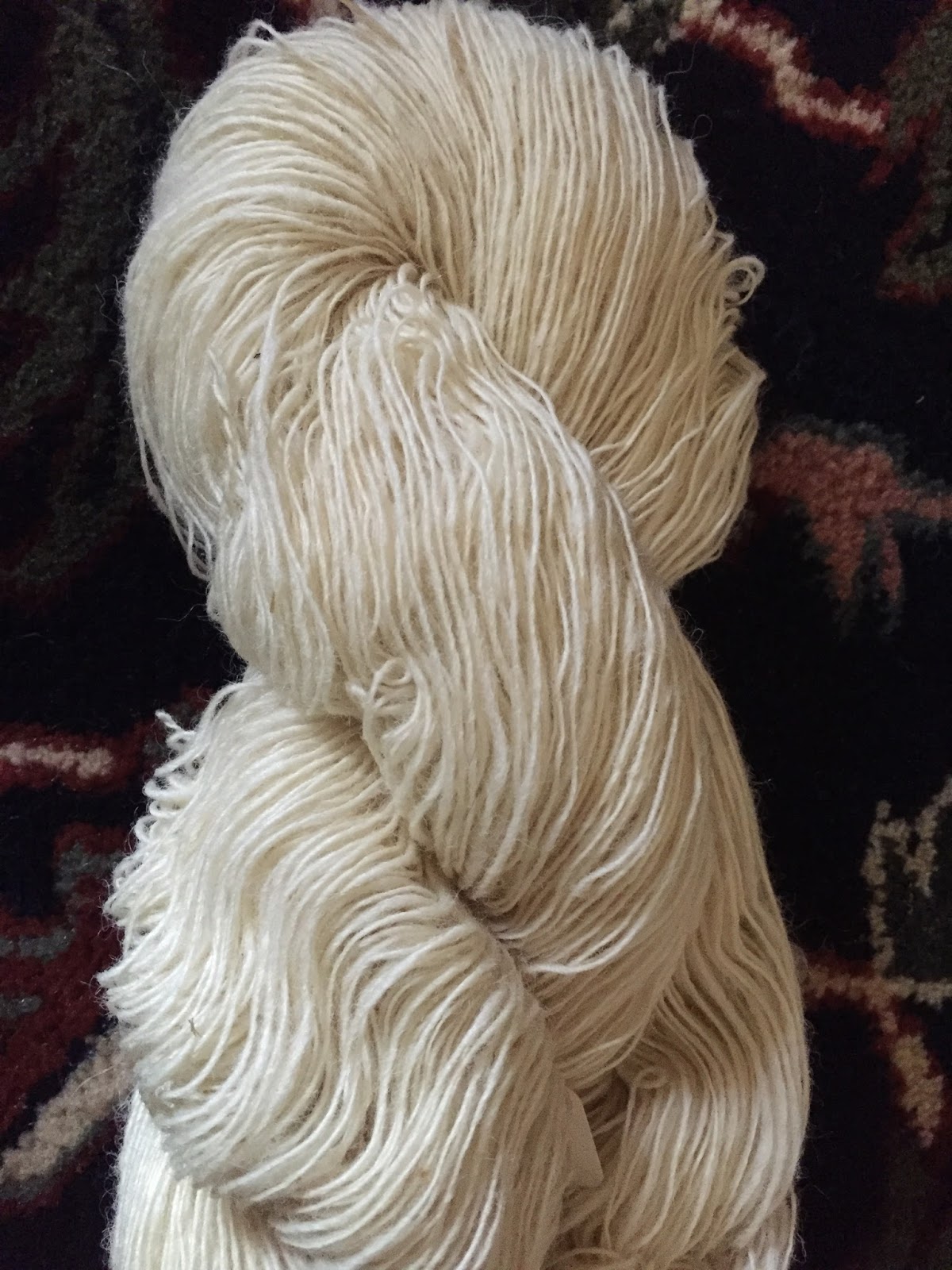
Skein of Romney singles
After my bobbins are full, I wind them off and, as I do, I count the yardage. This yarn winder has pegs at 72 inches, which means each round holds 2 yards. I count them into groups of 50, adding markers so that if I get interrupted, I can confirm the length. After removing it from the winder, I twist it into a skein and add a tag with breed and length. (I add weight and wii during the weigh-in.)


I keep a record of my yarn that includes:

  • Date finished
  • Weight of the skein
  • Length of the yarn in the skein
  • Wraps per inch (wii)
  • Technique: Long draw, short draw, etc.
  • Final product: Singles, plied, etc.

As you can see in the skein at right, there is still some twist. For the cowl, I soaked the skein of Merino singles and hung it to dry with some weight on the bottom of the skein. The cowl has no discernible twist--none that I can tell anyway.

Tuesday, March 29, 2016

Spring rites

Sheep in queue

Sheep shearing 2016

When scheduling a shearer for an early spring shearing, a  major concern is rain. Everybody gets wet (and cold) and finding a covered place for the skirting table just adds one more planning element to an already crazy-busy day. 

But this year's March day couldn't have been better. It was a spectacular meteorological gem. Sunny, dry and cool. Just perfect.

This year there were only eight ewes to be shorn and M. and I were able to stay ahead of the shearer--if only just barely. With years of experience, Hoyt Emmons shears each sheep smoothly and efficiently. Once he is done and steps aside, the quickly haltered sheep gets personalized care and its fleece moves to the skirting table. 

Stage two: Skirting
My standing assignment is at the skirting table. You can see the table in the photo at right below. It's a large wooden frame fitted with spaced PVC pipes that roll, allowing unwanted pieces to fall through. After identifying which end is which, that is, head vs. rear, the work begins.

The sheep at Winters' Past Farm wear coats, which keeps their fleeces clean, so most of the fleece needs no special attention. But what was outside the coat--the neck and upper chest and the belly wool in particular--does. The head and neck area often has so much vegetative matter that it must be removed. The back end has its own issues, but it's a straightforward cleanup, as are the belly sections. As Kris reminds us, anything that clunks, goes.

Once skirted, the fleece is folded into thirds, rolled up, bagged and tagged. This is the first round of cleanup. Kris will meticulously skirt the fleeces again sale. 

You may recall my frustration last fall when I assumed ownership of an orphaned sale fleece that was so contaminated with excrement and vegetation that after picking through it, only a fraction of the fleece--about one and a half pounds--was usable. 
On the skirting table, outer side up.                           Skirted fleece, cut side vs. outer side on first fold
The last fleece comes off--and what a beauty!

There was some dismay, but no surprise, when one ewe's fleece had a break in her wool. She'd had a stressful winter after she added quadruplets to the flock. 

But the last sheep in queue was a beauty. Just look at that fleece!

I almost--hear that? almost!--broke my vow and bought the fleece right then and there. It is that nice. 
I don't know what was more fun to watch--the lambs or the kids at play.

Tuesday, March 22, 2016

Needle action

Felted fiber hot off the FeltLOOM

A felting loom speeds fiber to felt

Needle felting is fun, costs little to get started and is portable. But it's hardly suitable for making larger pieces like those beautiful hats and jackets that I so admire. 

For that order of felting, you need the big guns of the fiber felting world. 

I had heard of felting machines, but had not seen one in action. Indeed, the machines, which are designed and manufactured in Kentucky, are quite impressive. Kris and I spent Sunday afternoon seeing what the FeltLOOM would do with a bag of roving. 

After laying out the requisite three crosshatched layers of roving, the rollers grabbed it,  rolled it under hundreds of felting needles and spit it out as a flat and felted sheet. It took us far longer to lay out the roving than for the needles to felt the material. And no Band-aids are needed for this operation: The needles are safely contained within plexiglas-like shields.

It was a fun afternoon....and although it is one piece of equipment that I do not intend to acquire, my crazy mind still generates possible projects and 'what if's.' 


Fiber on the felt loom


Monday, March 7, 2016

Guilds rock

An homage to fiber guilds and their members

Terry's Deflected Double Weave


Currently, membership in groups of all kinds is at an all-time low. The causes, of course, are varied but two things are commonly cited: Time--people are busy--and the Internet. Why attend a meeting when all the information is online?
Mary's Rhododendron tapestry

The Internet may be an awesome resource, but there is nothing like the personal experience of sharing with others. And whether you're looking for inspiration or information, a guild is the place to find it.  


I recently attended two guild meetings. One was the New York Handweavers Guild's annual show-and-tell. Sitting around a large table, members shared their projects from the past year. A wealth of information accompanied each piece. 
Some projects originated with a workshop the weaver had taken. Others were independent studies. Here are few I particularly liked--and their photos came out.

Mary designed three beautiful tapestries that were woven on a jacquard loom. Quite spectacular! (Rhododendron is above left.) 

Perhaps because the South Jersey Guild has been studying double weaves this year, I particularly liked Terry's deflected double weave. 
Cari's towel, Gebrochene pattern


And the linens! I confess that I've never been inclined to weave hand towels but I may have to reconsider after seeing some of the beautiful handwoven towels and that lovely damask napkin yardage.

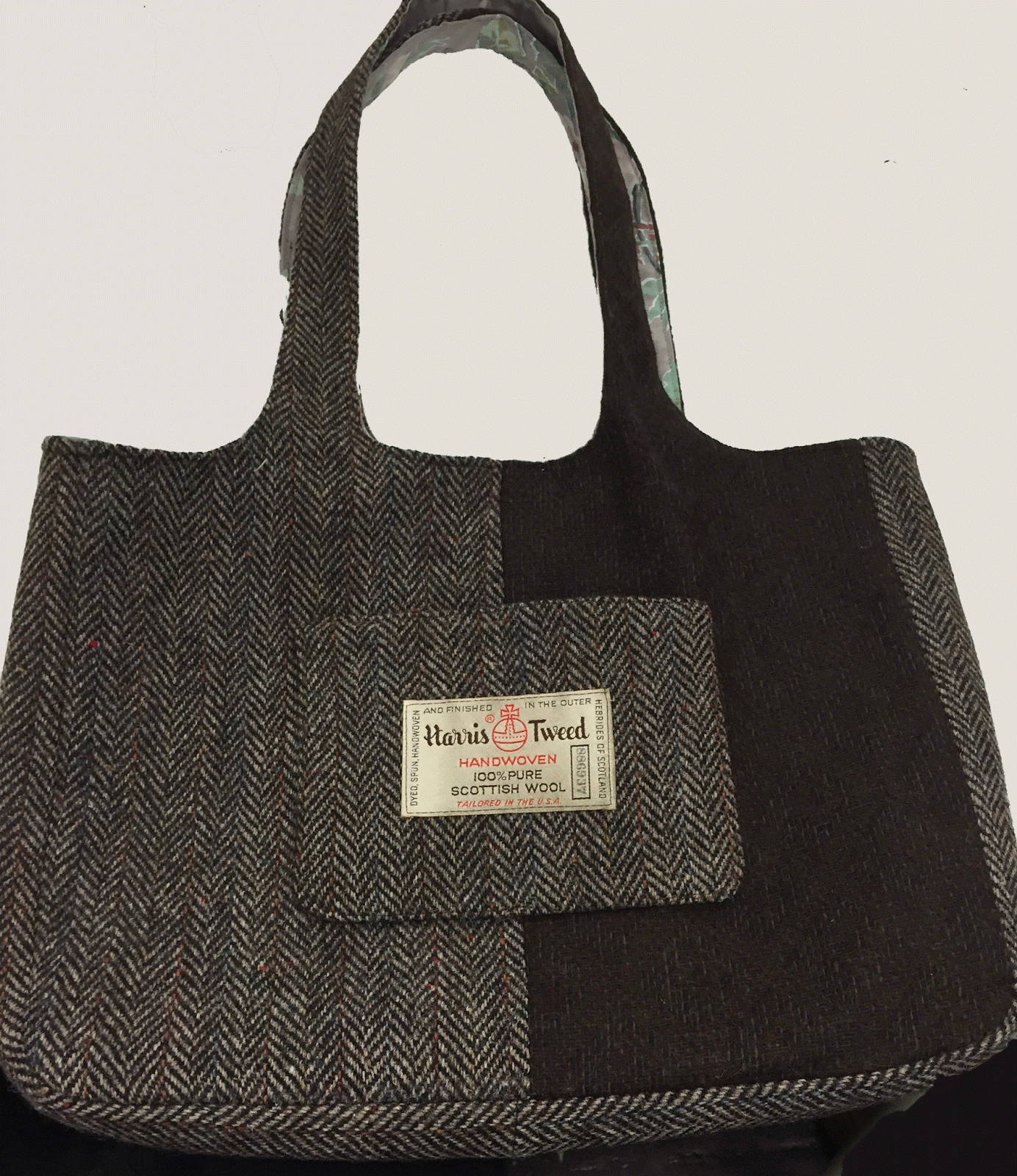
One project was the happy outcome of a favorite sweater that had been felted by mistake. (She made a vest and mittens.) She also made  tote that was upcycled from a Harris tweed jacket (below). Very clever!

Wrapping up...and down


The program at the South Jersey Guild of Spinners and Handweavers was led by Ellen Turner, who taught members how to make a dragon boat ornament. It's cleverly wrapped. No weaving, sewing, braiding or spinning involved.

Interested in finding a guild?

Here in the Northeast, there a number of guilds that are likely to be  within a reasonable distance. (The MidAtlantic Fiber Association, MAFA, counts nearly 60 in that region. For other locations, find a guild or club in your area at the Handweavers Guild of America.

Pam's tote
Pam's felted mittens

Monday, February 29, 2016

Extraordinary textiles from simple looms

Beautiful fabrics, magnificent colors--all woven on backstrap looms

Mara woman's mantle, 1983.

As a weaver, I was deeply humbled by the woven fabrics in the exhibition, Art of the Zo: Textiles from Myanmar, India, and Bangladesh at the Philadelphia Museum of Art. All of them woven on simple backstop looms. 

From small beads on the selvedges to tiny decorative stitches that decorate seams, the textiles show not only the technical  expertise of the weavers, but their sophistication in color and design.
Backstrap loom

I was captivated by the tunics, wrap skirts, mantles, loincloths, capes, and blankets and for the range of decorative techniques ranging from unpatterned indigo-dyed cloth to colorful stripes to complex weaves and thought you might enjoy them, too. But this is just a taste. There are many, many more in the exhibition.

The Mara woman's mantle, at top right, is described as a cotton warp-faced plain weave with discontinuous two-faced complementary weft patterning and countered weft twining. Woven by a Christian woman in India, Mizoram, Zawngling Village in 1983, it was worn to a christening.

Tashon man's ceremonial mantle
The mantle at right is a Tashon man's ceremonial mantle woven about 1960 in Myanmar. It is cotton warp-faced plain weave with discontinuous one-faced supplementary weft patterning. Look carefully at the small decorative horizontal stripe mid-way down. It seams together the long sides of the rectangular mantle and complements the design.

Below, the Mizo woman's ceremonial jacket, c. 1970-80, and ceremonial wrapped skirt, c. 1950-70, are typical of celebratory and funerary dress for married women in Myanmar, Northern Chin State or India. 
Mizo woman's ceremonial
jacket and skirt


Both the jacket and the skirt are woven of cotton woven in a warp-faced plain weave, but they differ in technique and patterning. The jacket woven structures include continuous one-face supplementary weft patterning and and discontinuous one-faced supplementary weft patterning. 

The skirt features discontinuous two-faced supplementary patterning, tapestry, weft-faced plain weave and red weft. Comprised of three lengths of cloth,it can also be worn as a mantle.
Khamau woman's tunic, c. 1900.


The Khamau woman's tunic, c. 1900, at right was a particular favorite. According to the signage, the Khama (Myanmar) are the only Zo people known to decorate their textiles with resist dyeing. Unfortunately, there have been few garments made in this tradition in the last 80 years. 

This exhibit, which includes items from the Museum’s collection of Zo textiles as well as loans from Barbara and David Fraser, authors of Mantles of Merit: Chin Textiles from Myanmar, India, and Bangladesh (2005), is well worth a visit for anyone interested in textiles.

The exhibit is in the Perelman Building of the Philadelphia Museum of Art and runs to March 20, 2016.