Showing posts with label spinning yarn. Show all posts

Monday, July 25, 2016

A fine fleece

Two types of fiber, side by side
Or not

When the fleece came off the ewe in March, it shone silver gray and lustrous in the sun. I was definitely tempted to take it home then and there, but I had sworn a pact to myself that I would not bring home another fleece. I said, no. 

Later, the fleece came up in a discussion among friends and one immediately offered to split it with me. The fleece came home.

Determined not to let it sit for months, I immediately scoured it using Beth Smith's Simple and Mostly Quick method. When it was dry, I set to work carding it with visions of spinning in my mind.


Gnarly black fibers

A silk purse, it isn't

Were I more experienced, I surely would have recognized the problem, but I'm not and I didn't. 

Putting it through the carder was hard. The licker filled and the drums locked. I attributed it to poor fiber prep and spent too much time going through the fleece, pulling it apart and trying to release any sticky bits with a small comb. 

And I kept trying. But even with all the prep and  four passes through the carder, there were still lots and lots of gnarly, nubby black bits. Clearly, the fleece would not be suitable for handspinning. But what is the problem?

That was when I stepped back and examined the locks very carefully. At the base of most of the locks was a snaggly clump of black fiber. It was extremely hard to separate from the locks. Pulling on a lock did not separate it. Rather, the fibers locked together and felt like wire. I didn't have the black fiber tested, but it looked and felt much coarser than the gray fiber. (Note: These were different from the dark fibers in the photo at top right.)


Gnarls in carded batt
I took photos and shared them, along with questions, with more knowledgable spinners. 

Turns out the ewe was double-coated. She shouldn't have been. But she was. And, interestingly, double-coated sheep are typically described as having a longer, coarse outer coat and a short fine undercoat. This is the exact opposite. The outer coat is long and fine and the undercoat, coarser. Some obscure, long recessive gene had clearly expressed itself. 

Now what?

I finished carding what seemed the most suitable, cutting the base of the locks with scissors. I still have gnarls throughout the batts. And I now have a lot of carded batts with gnarls. Maybe a felting project is in my future?

I didn't even try to card the coarser black fibers. But I didn't throw them away, either. More next week.

Monday, April 4, 2016

Spinning to knit

Pinelands Spring cowl
Yarn: single ply handspun Merino

I have a basket full of handspun. Now what?

Last year, I had bags of roving piled in my studio. This year, the bags had been transformed into yarn. I am pretty much happy with the yarn, but the more I spun, the more satisfied I became. 

Over the years, I have spent far too much time dwelling on my frustration in spinning larger gauge yarns. As I was sharing this with other spinners, the reality hit me: I prefer to work with finer gauge yarns. Why do I need to spin larger gauge yarn? I don't. 
Yarn being wound from the bobbin

So after freeing myself from 'should do's,' I have moved on to focus on spinning fine to medium yarns for consistency. Should I get bored, I can add any number of challenges by spinning wool from different breeds. 


Consider the breed

Winter's Past Farm raises Coopworth sheep and I can't say enough good things about spinning their fleece. At the top of the list is 'easy to spin.' I also like the color, which accepts dye easily. I had some Tunis and found spinning that about the same as the Coopworth. Then I moved on to the Dorset, a down wool, and Merino, a fine wool, both with shorter staple lengths.

Then Romney, which I was gifted at the local guild's Rock Day celebration. Easy to spin but for one major negative totally attributable to the shearer. It was riddled with second cuts--short lengths of wool from the shearer's second pass on the sheep. The short fibers form noils, which defeat smooth, even yarns and are the very devil to pick out when spinning. 
Counting as I wind on

This year's focus was on spinning singles suitable for knitting. That meant taming the twist as much as possible. With this goal, I've been spinning these with a short draw with my wheel ratio set as slow as possible. 

My first project through to completion was Pinelands Spring  cowl knit with Merino singles on a knitting machine. The pattern itself adds an exaggerated stitch in the rib variation, which in itself adds texture but doesn't draw attention to any inconsistencies in the yarn. (If you like the pattern, it's available as a free download on Ravelry.)


Spinning data

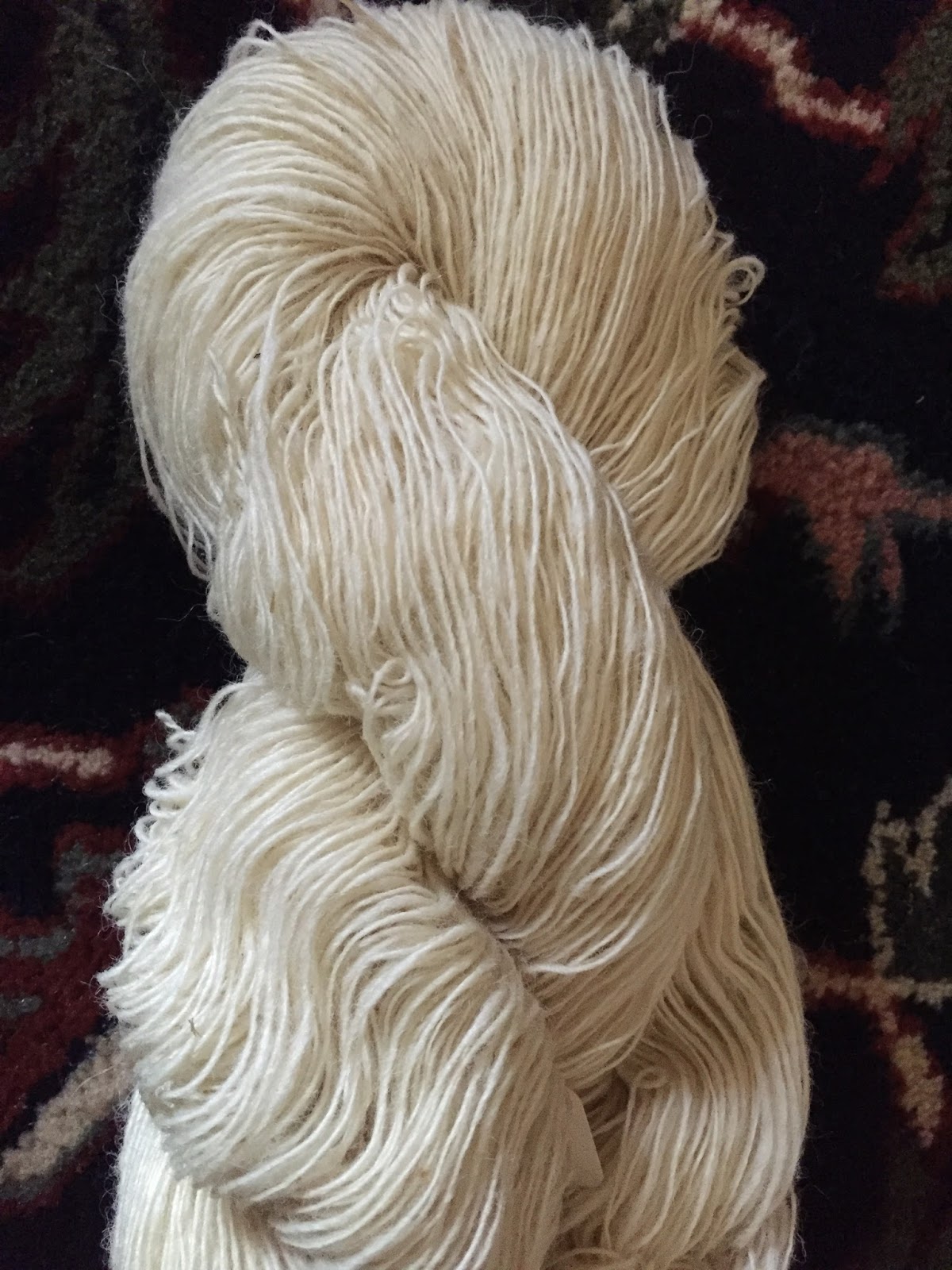
Skein of Romney singles
After my bobbins are full, I wind them off and, as I do, I count the yardage. This yarn winder has pegs at 72 inches, which means each round holds 2 yards. I count them into groups of 50, adding markers so that if I get interrupted, I can confirm the length. After removing it from the winder, I twist it into a skein and add a tag with breed and length. (I add weight and wii during the weigh-in.)


I keep a record of my yarn that includes:

  • Date finished
  • Weight of the skein
  • Length of the yarn in the skein
  • Wraps per inch (wii)
  • Technique: Long draw, short draw, etc.
  • Final product: Singles, plied, etc.

As you can see in the skein at right, there is still some twist. For the cowl, I soaked the skein of Merino singles and hung it to dry with some weight on the bottom of the skein. The cowl has no discernible twist--none that I can tell anyway.