Showing posts with label sheep. Show all posts

Monday, April 4, 2016

Spinning to knit

Pinelands Spring cowl
Yarn: single ply handspun Merino

I have a basket full of handspun. Now what?

Last year, I had bags of roving piled in my studio. This year, the bags had been transformed into yarn. I am pretty much happy with the yarn, but the more I spun, the more satisfied I became. 

Over the years, I have spent far too much time dwelling on my frustration in spinning larger gauge yarns. As I was sharing this with other spinners, the reality hit me: I prefer to work with finer gauge yarns. Why do I need to spin larger gauge yarn? I don't. 
Yarn being wound from the bobbin

So after freeing myself from 'should do's,' I have moved on to focus on spinning fine to medium yarns for consistency. Should I get bored, I can add any number of challenges by spinning wool from different breeds. 


Consider the breed

Winter's Past Farm raises Coopworth sheep and I can't say enough good things about spinning their fleece. At the top of the list is 'easy to spin.' I also like the color, which accepts dye easily. I had some Tunis and found spinning that about the same as the Coopworth. Then I moved on to the Dorset, a down wool, and Merino, a fine wool, both with shorter staple lengths.

Then Romney, which I was gifted at the local guild's Rock Day celebration. Easy to spin but for one major negative totally attributable to the shearer. It was riddled with second cuts--short lengths of wool from the shearer's second pass on the sheep. The short fibers form noils, which defeat smooth, even yarns and are the very devil to pick out when spinning. 
Counting as I wind on

This year's focus was on spinning singles suitable for knitting. That meant taming the twist as much as possible. With this goal, I've been spinning these with a short draw with my wheel ratio set as slow as possible. 

My first project through to completion was Pinelands Spring  cowl knit with Merino singles on a knitting machine. The pattern itself adds an exaggerated stitch in the rib variation, which in itself adds texture but doesn't draw attention to any inconsistencies in the yarn. (If you like the pattern, it's available as a free download on Ravelry.)


Spinning data
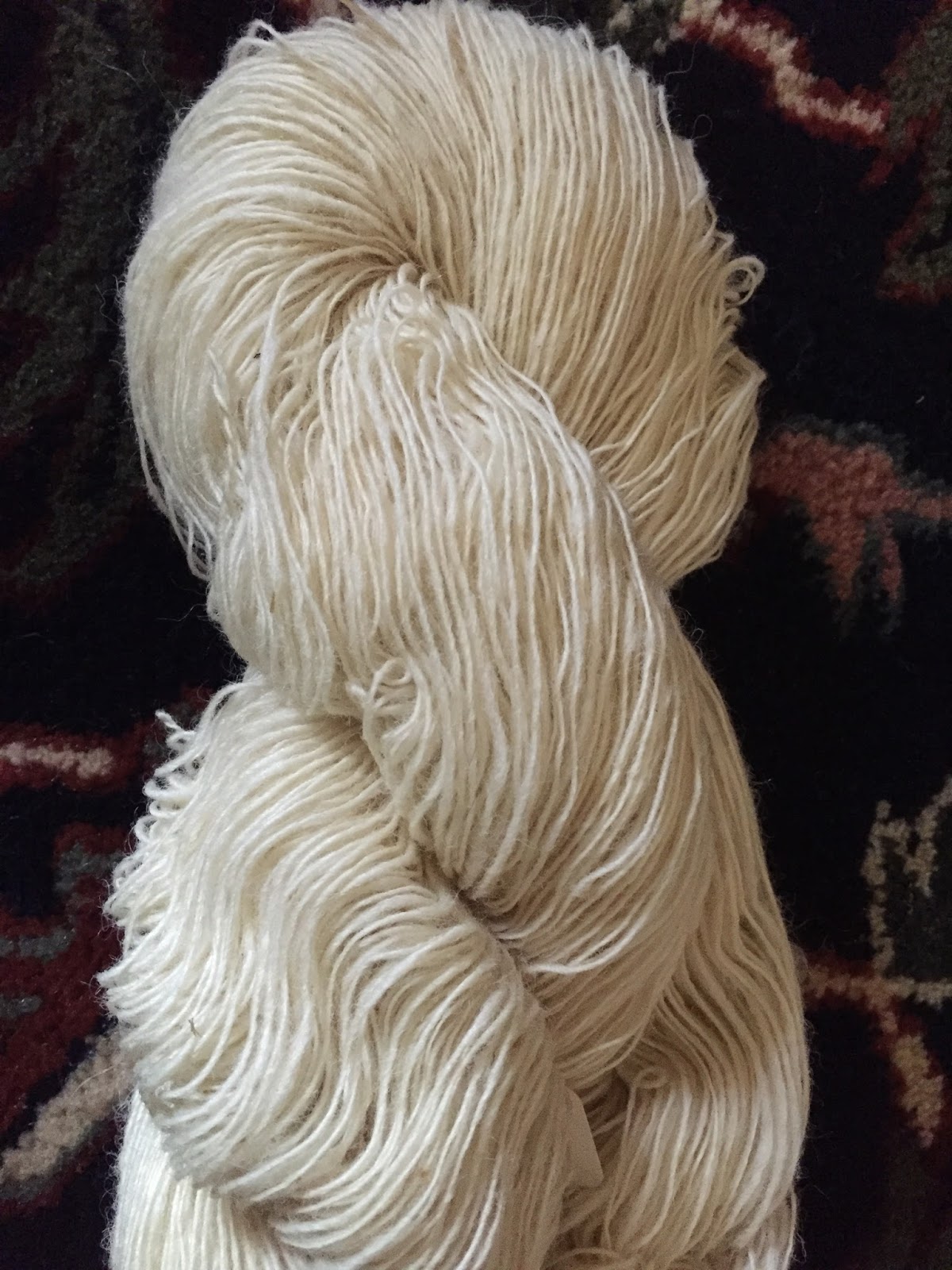
Skein of Romney singles
After my bobbins are full, I wind them off and, as I do, I count the yardage. This yarn winder has pegs at 72 inches, which means each round holds 2 yards. I count them into groups of 50, adding markers so that if I get interrupted, I can confirm the length. After removing it from the winder, I twist it into a skein and add a tag with breed and length. (I add weight and wii during the weigh-in.)


I keep a record of my yarn that includes:

  • Date finished
  • Weight of the skein
  • Length of the yarn in the skein
  • Wraps per inch (wii)
  • Technique: Long draw, short draw, etc.
  • Final product: Singles, plied, etc.

As you can see in the skein at right, there is still some twist. For the cowl, I soaked the skein of Merino singles and hung it to dry with some weight on the bottom of the skein. The cowl has no discernible twist--none that I can tell anyway.

Tuesday, March 29, 2016

Spring rites

Sheep in queue

Sheep shearing 2016

When scheduling a shearer for an early spring shearing, a  major concern is rain. Everybody gets wet (and cold) and finding a covered place for the skirting table just adds one more planning element to an already crazy-busy day. 

But this year's March day couldn't have been better. It was a spectacular meteorological gem. Sunny, dry and cool. Just perfect.

This year there were only eight ewes to be shorn and M. and I were able to stay ahead of the shearer--if only just barely. With years of experience, Hoyt Emmons shears each sheep smoothly and efficiently. Once he is done and steps aside, the quickly haltered sheep gets personalized care and its fleece moves to the skirting table. 

Stage two: Skirting
My standing assignment is at the skirting table. You can see the table in the photo at right below. It's a large wooden frame fitted with spaced PVC pipes that roll, allowing unwanted pieces to fall through. After identifying which end is which, that is, head vs. rear, the work begins.

The sheep at Winters' Past Farm wear coats, which keeps their fleeces clean, so most of the fleece needs no special attention. But what was outside the coat--the neck and upper chest and the belly wool in particular--does. The head and neck area often has so much vegetative matter that it must be removed. The back end has its own issues, but it's a straightforward cleanup, as are the belly sections. As Kris reminds us, anything that clunks, goes.

Once skirted, the fleece is folded into thirds, rolled up, bagged and tagged. This is the first round of cleanup. Kris will meticulously skirt the fleeces again sale. 

You may recall my frustration last fall when I assumed ownership of an orphaned sale fleece that was so contaminated with excrement and vegetation that after picking through it, only a fraction of the fleece--about one and a half pounds--was usable. 
On the skirting table, outer side up.                           Skirted fleece, cut side vs. outer side on first fold
The last fleece comes off--and what a beauty!

There was some dismay, but no surprise, when one ewe's fleece had a break in her wool. She'd had a stressful winter after she added quadruplets to the flock. 

But the last sheep in queue was a beauty. Just look at that fleece!

I almost--hear that? almost!--broke my vow and bought the fleece right then and there. It is that nice. 
I don't know what was more fun to watch--the lambs or the kids at play.

Thursday, July 16, 2015

Sheep business

So many choices at Valley Shepherd Creamery!

Bring on the cheese, yogurt and ice cream!

By now you know that I love wool and all its permutations, but there is more to sheep than fleece and lamb chops. A visit to Valley Shepherd Creamery in Long Valley, NJ had been on our bucket list for too long a time. 

It was a perfect day trip. Once off the expressways and spaghetti interchanges, the road took us through some of Somerset County's historic villages and beautiful countryside. 

Set on 120 acres, the Creamery offers tours of its operations. On summer weekends, they're on weekends. Unfortunately, we were there on a day when only the shorter 45 min. tour was available. It allowed us to see the cheesemaking room, the milking parlor and a view into one of the sheep sheds, but was restricted to the main shop building. The website does not provide details, so if you go, I'd recommend a phone call to the farm to find out when the full tour is scheduled as the cost is the same for both.


A day for a picnic

Picnic on the porch
As suggested on their website, we took a bottle of wine and picnic basics, planning to feast on bread and their cheese. We bought an excellent soppressata (not made locally) and Creamery cheeses that would not be on the tasting tray. We tried Oldwick Shepherd, a Basque-style sheep cheese, two goat cheeses--Very Goat and a chèvre cheese--and Crema de Blue, a Jersey cow milk cheese and American Cheese Society award winner. Then we finished our lunch with sheep's milk gelato. Yum.


Behind the cheese case

Valley Shepherd Creamery Milking Parlor
The Creamery has steadily grown since its beginning 15 years ago. It makes goat and cow cheeses, but sheep's milk cheeses are its legacy and at the heart of its artisanal cheese-making business. 

Sheep milk is richer than cow or goat milk and, according to Sheep101, yields more  cheese due to its higher in fat content, solids and protein. 

By their own description, the Creamery is a  small operation with a flock of 600 Dutch Friesian Milk Sheep. Ewes are bred in the fall and lamb in the spring. Milking operations begin at that time and last until November, when the ewes stop producing milk. 

The milking parlor, which is described as the only one of its kind in the U.S., was designed by the Creamery's owners, who were trained as engineers. It looks like a high-tech merry-go-round. And it pretty much operates like one.

The ewes enter the apparatus single file. Once in a station, the ewe is stabilized and attached to the milking machine. Pacified with a small amount of grain in the feed bin, they circle on the milking parlor and exit about two minutes later via a second chute.


Cheesemaking central
Compared to cows, which produce between 55 to 100 pounds of milk a day for at least a  year, sheep don't produce a lot of milk. A Creamery sheep averages three to four pounds a day for about six months after lambing. 

When the sheep don't give milk, the Creamery doesn't make sheep cheese. But it also has cows and goats that provide milk to support ongoing cheesemaking.

Friesian sheep are noted for their dairy production. Not for wool production. Ewe fleeces average 9 to 12 pounds, reports raisingsheep.net, but the average fiber diameter is 29-33 microns, and a USDA wool grade 46's-54's. The farm shears its sheep and, according to its website, has blankets made from the wool. The shop had a few pelts for sale and a few yards of alpaca from their flock.

Farm to market

The Creamery's distribution channel is direct. It sells wholesale to restaurants and has steadily expanded its direct-to-consumer markets in the New York and Philadelphia regions. It has cheese shops in both cities and sells its products at more than 24 local farmers' markets in the region. A relatively recent addition to the Creamery brand is MeltKraft, a grilled cheese sandwich bar.

Now I'm ready for a trip to Reading Terminal Market for a grilled cheese sandwich. 

Tuesday, March 31, 2015

Shearing day

Three bags full

View from the skirting table

Weather here in the northeast interfered with the normal run of late winter activities. Some events were cancelled, some went on without us, and some were rescheduled.

Shearing day was a reschedule. Usually the end of February or the beginning of March, the event at Winter's Past Farm's was delayed until the end of March. According to our shearer, most shepherds in this region have pushed the date by about a month this year. 

Sheep in queue
The fleece skirting table is our domain. There were three of us on this detail this year. We clean up the newly-sheared fleece, bag it, and keep moving. Our goal is to get rid of most of the worst. K. keeps her sheep covered, which results in a significantly cleaner fleece, but the neck area always has hay bits from the feeder and the tail--well, no need to explain the stuff at that end. It all needs to go.

This is just the first pass, but if we don't remove the bulk of of the hay and excrement, they will contaminate the entire fleece. It will be worthless. 
The coat comes off

The market

The market for small shepherds is spinners and other fiber artists. The circle is small. It's important to maintain credibility as a shepherd who produces clean fleece. 

The fleeces go to market in various states. Spinners and felters may buy a sheep's entire fleece, but the fleece is often spun into roving, which is clean and ready to spin. 

Fleece that doesn't meet the quality mark for spinners is still useful and makes its way to markets as craft products that are often felted.
The ram goes first

From the sheep

The ram was first. He is a big one, but under the shearer's control, docile and quiet. 

As the fleece falls from the sheep, it's always a delight to see the color and luster of the wool beneath. 
The color and luster beneath

When the sheep has been shorn, haltered and moved away, the skirting team moves in to pick up the fleece from the ground and move it to the skirting table.

To the skirting table

As pickers, our goal is to keep up with the shearer, that is, we need to be done with skirting by the time the next sheep is shorn. (Sorry, no photos this year of the fleece on the table.)

Bagging the rolled fleece
The fleece skirting table, seen below, has served us well. M. made the wood frame table about 10 years ago. PVC pipes, which roll within a solid wood frame, allow us to move the fleece around, let the less desirable bits fall through to the ground, and provide a solid base to roll the fleece for bagging. The unit sits on two sawhorses.

A dear departed friend, who was a member of this team for years, declared us official members of the ISSPP (International Society of Sheep Poop Pickers). 'Tis true. We pick a lot of poop.


One step closer to market


The bags are full, but the fleece isn't ready for market. K. will open each bag and in many cases, lay them out to thoroughly dry. (It's been a particularly wet year here.) Then she'll go through each of them again to ensure a clean fleece with quality fibers. Some is sold before shearing as fleece and some as roving. And some will go to local and regional markets, including Maryland Sheep and Wool, King's County Fiber Festival in Brooklyn, or Rhinebeck. 


Truly, a direct to consumer operation.


Sunday, November 3, 2013

Book review: The Field Guide to Fleece

The Field Guide to Fleece: 100 Sheep Breeds & How to Use Their Fibers,  by Carol Ekarius and Deborah Robson and published by Storey Publishing offers a bonanza of information on fleeces of 100 sheep breeds. It includes sheep breeds commonly raised in the U.S, but is an excellent reference guide to heritage and lesser known breeds. The book is well laid out with representative photographs of each breed and plenty of information.

The authors have compiled basic information on numerous breeds and distilled it into a standardized format that includes origin of the breed, size and type of each breed’s fiber, and best uses for their fleeces. I loved leafing through the pages to discover breeds I’d never heard of—many of which I am unlikely ever to see.

I read the digital version of the book, but have since seen a print version, which is somewhat larger than most books distributed as field guides. It’s a bit too large to tuck in a back pocket, but since most people carry bags big enough to carry home fleece and yarn, it’s not really much of an issue.

My only other wish was that for ease of use, I would have like to see a table of breed and the fleece characteristics for quick reference at fleece shows and sales.


This is not only a reference book that should find a place on every adventuresome spinner’s bookshelf, but one that is sure to accompany many a spinner to fleece sales—especially those that include fleeces beyond the more common sheep breeds.