Thursday, October 15, 2015

Fiber festivals and markets

Gleaning data from preferences and purchases.

Winter's Past Farm at Kings County Fiber Festival
From writing a business plan to developing and offering products and services, small business face the same hurdles as large corporations. Where are the opportunities? Who are the potential customers and what do they need and/or want? Bottom line: What will sell?

Large companies spend a great deal of time and money identifying their market as it is key to strategy and to profitability. Small business owners need the same information, but gathering it is a slower and less structured process. No outsourcing, no big data to crunch. 

Pricing is important, but understanding potential buyers comes first. Who are they? What interests them? What will appeal to them? And perhaps most importantly, where are the opportunities? 


Two fiber festivals. Two markets.

Among others, Winter's Past Farm is a regular exhibitor at Garden State Sheep and Fiber Festival, a weekend event in mid-Jersey, and Kings County Fiber Festival, a Saturday event on Columbus Day weekend in Brooklyn. I'm focusing on these two here.

Although only about 50 miles apart the two festivals are very different. 

Garden State Sheep & Fiber Festival 
Type of festival: Hosted by Garden State Sheepbreeders, the event features a two-day sheep and fiber livestock show. A community event that also draws serious fiber folks from an estimated 40 mile range in central New Jersey. 
Date: Second weekend in September.
Location: Set amidst farmlands in a county agricultural fairground's dim and dusty barns
Weather: The 2014 weekend was brutally hot vs. this year, which was beautiful. The crowd seemed smaller this year, but once tallied, sales figures were the same year over year.

Kings County Fiber Festval
Type of festival: Street festival. Lots of families, but far fewer serious fiber folks. 
Date: Saturday of Columbus Day weekend.
Location: Park Slope, Brooklyn, New York
Weather: Comparing year over year, we noted that about half the 2014 vendors bailed out due to heavy rain. However, once the rain cleared, there was a flood of customers and business was brisk. This year, it was a spectacular fall day and all vendors showed up. It certainly seemed that there were fewer customers. Did more people travel over the beautiful long weekend?

As we pondered differences, we also noted different purchasing preferences, both year over year and between the two festivals. For me, the most dramatic difference was the preference between two knit accessories.

I had taken two recently released patterns--The Peacock's Gift, a singular shawl in striking royal blue (below, left), and Jersey Waterways, a versatile cowl in a lightly variegated gray (below, right). 
Jersey Waterways*
The Peacock's Gift*

At Garden State, the Peacock's Gift was the clear attention-getter and the sole source of pattern revenue. There was little interest in Jersey Waterways.

In Brooklyn, preferences were exactly opposite. Interest was almost solely on the Jersey Waterways. I sold out of the printed patterns! (Both are available on Ravelry.

Was it color? The weather--surely a factor but how important? And what about the demographics? I'll probably never know the answers--and there is nothing to suggest that things won't change next year. But I'm reassured that knitters like what I'm doing, so I'll just keep designing what I like--and listening and watching for reactions. 

*Model: Lauren Valletutti. Photographer: Maurice Marietti

Thursday, October 8, 2015

Camp gamps

63 twill variations for weaving ideas and inspiration

Twill gamp #1
Seven weavers each brought a portable loom. Each was threaded with three different twill patterns separated by two threads of a contrasting thread. Those are the vertical lines in the photos. 

As mentioned in my last post, each weaver wove three different treadling sequences, weaving two picks of a third contrasting color to separate one patterns before moving to the next.  sequence. Those are the horizontal lines in the photos.

Two days. Seven samples. Nine patterns on each gamp. Sixty three variations on twill.
Twill gamp #2
Twill gamp #3 (Incomplete sample)

Twill gamp #6

Lessons learned

In the workshop, each weaver tagged her gamp, which brings me to a cautionary tale. If you use white tags to identify designs and patterns, make sure they can survive your finishing method. Tags that disintegrate in water are a big problem for fabrics that need wet finish and/or blocking. 

Twill gamp #7
These gamps weren't woven for beauty. Time was tight and weaving, as quickly as possible. That meant that selvages weren't as tidy as they would be in a finished piece and minor mistakes were ignored. That extra white line in twill gamp #6? I lost my place in the treadling order and rather than undo the picks, I marked the point of error and kept weaving.

The master plan was that weavers plan to weave on their loom last, so that if time ran out--as it did, they could finish the sample at home. 

The gamps shown here have all been wet finished by hand washing (in Dreft), rinsing and ironing when dry.

Evaluating patterns

Some patterns appeal to me more than others, but I can see at least one design potential in each of the gamps. Some, I've discounted due to floats that would make the fabric unstable. (Note the middle section in Twill gamp #2.)

Twill gamp #6, at left, looked very different after wet finishing. Just off the loom, the squares were distinctly square, but not after finishing. Were I to use any of those twills, I'd  need to make sure I either beat lighter or planned for significant lengthwise shrinkage.

Others I'm disinclined to weave because the results aren't significantly different enough to justify weaving a three-pick color pattern. That was true for twill gamp #3 on which progress was slow and I was running short on time. I ended the pain and moved on.

Now that these are finished, I'll put them in a notebook with their threading and treadling patterns and add another valuable addition to my fiber resource library.

*Extra marks if you noticed that #4 and #5 are missing. Time ran short. Number 5 is on my loom to be woven and shared with the person who didn't get to it and #4's loom owner has promised to weave off an extra gamp when she does hers. 

Monday, October 5, 2015

Gamp camp

A workshop with no relationship to Sarah Gamp's brolly.

8-Harness Schacht with twill gamp begun
Odd word, gamp. According to oxforddictionaries.com and every other online resource I found, 'gamp' is a British colloquialism for an umbrella that derives from Charles Dickens' character Sarah Gamp, a nurse with a large unwieldy umbrella in Martin Chuzzlewit. I found not one reference related to weaving.

Yet gamp is a real word used by weavers to describe a sampler--and samples are as essential to weavers as gauge swatches are to knitters. (If you know the origin, please share!)

On the loom, fibers, colors and patterns don't always behave as expected. And the time to find that out is before the project is warped, the loom dressed and the weaving begun.

Gamp camp in Medford

Last weekend, the South Jersey Guild of Spinners and Handweavers hosted a weekend workshop with Karen Donde to explore the possiblities of color-and-weave effects in twill patterns. Seven of us arrived on Saturday morning, each with a loom dressed with 5/2 cotton in two contrasting colors. There were four- and eight-harness looms, each threaded with three different patterns across the 12 inch width and ready to weave.


Ashford table loom
This was a round robin event, meaning that each person wove a sample on each of the seven looms. For those who didn't own a portable/sample loom, it was an ideal opportunity to try out different maker's equipment. I particularly liked the Louet, which had its own stand, and the Ashford table loom (at right). I have an eight-harness Schacht table loom and stand that M. built for it. (Works a charm, but confused some people because the levers are right to left. Are they still made that way? I don't know.)

Each loom was matched to a treadling pattern with directions for three different treadlings, which resulted in nine different variations for each twill gamp. 

At the end of the second day, the fabric was cut from the looms and cut apart so that each participant several twill gamps. After I secure the ends and wet finish mine, I'll share photos here.
Vintage table loom

Why do this? To find patterns suitable for upcoming projects, of course. Among the nine options, there is likely to be one--or more--that look promising. Gamp are not end projects. Rather, they are resources for future projects. It's a beginning. Most (all?) projects will call for changes--fine-tuning, if you will. Different colors, yarns, beat, etc. 

Weaving a twill gamp is a good exercise. Handweavers Guild of America provides directions for threading and treadling a twill gamp here.

Thursday, September 24, 2015

Swatches rule

Project swatches, planning swatches and swatches "just because"

Swatch for Pine Tree, Version I with labeled tag
I love swatches, but I confess: I didn't always. There were years I resented the command, considering it time that could be better spent working the pattern. 

No more. Now I'm an inveterate swatcher -- and not just for gauge. It's essential to my designs.
Knit swatch attached to directions

For knitting, I am a huge Barbara Walker fan and her Treasury series of pattern books, a four book compendium crammed full of ideas and possibilities. Although a photo accompanies each pattern, the knit swatch often doesn't live up to the photo. Trust me on this one.

Periodically, I go through the pattern books and mark the ones that look interesting. I copy the directions and paste each to a 4x6" index card. Then, when I'm too tired to do much else, I'm traveling or I'm  between projects, I work my way through my patterns of interest. 

I like to knit 4 to 6 inch square swatches and label each with the name of the pattern, the book and page number on small white tags. After soaking and blocking them, I attach the cards and they become part of my ever growing library of possibilities. 

And, yes, I have other libraries, including braids, woven swatches, and dyed yarn. They not only are sources of inspiration and points of departure for projects, but if I've documented the work, I'll have laid the groundwork for what works, what doesn't and yardage.


Working without a swatch

Recently, I've had my head down working on my own knit and braid designs and really needed to just make some thing that required little more than following directions.  

As above, and in a prior post, I ranted a bit about the need for swatching and what did I just do? I started a project and didn't make one. To be fair, I didn't because the pattern had no gauge. I'm guessing the gauge is based on the standard gauge on the yarn wrapper. A swatch probably isn't essential for the single-size pattern, but I'd still feel more confident in sizing if I were working to one. 

Note the size variation in the pick yarn
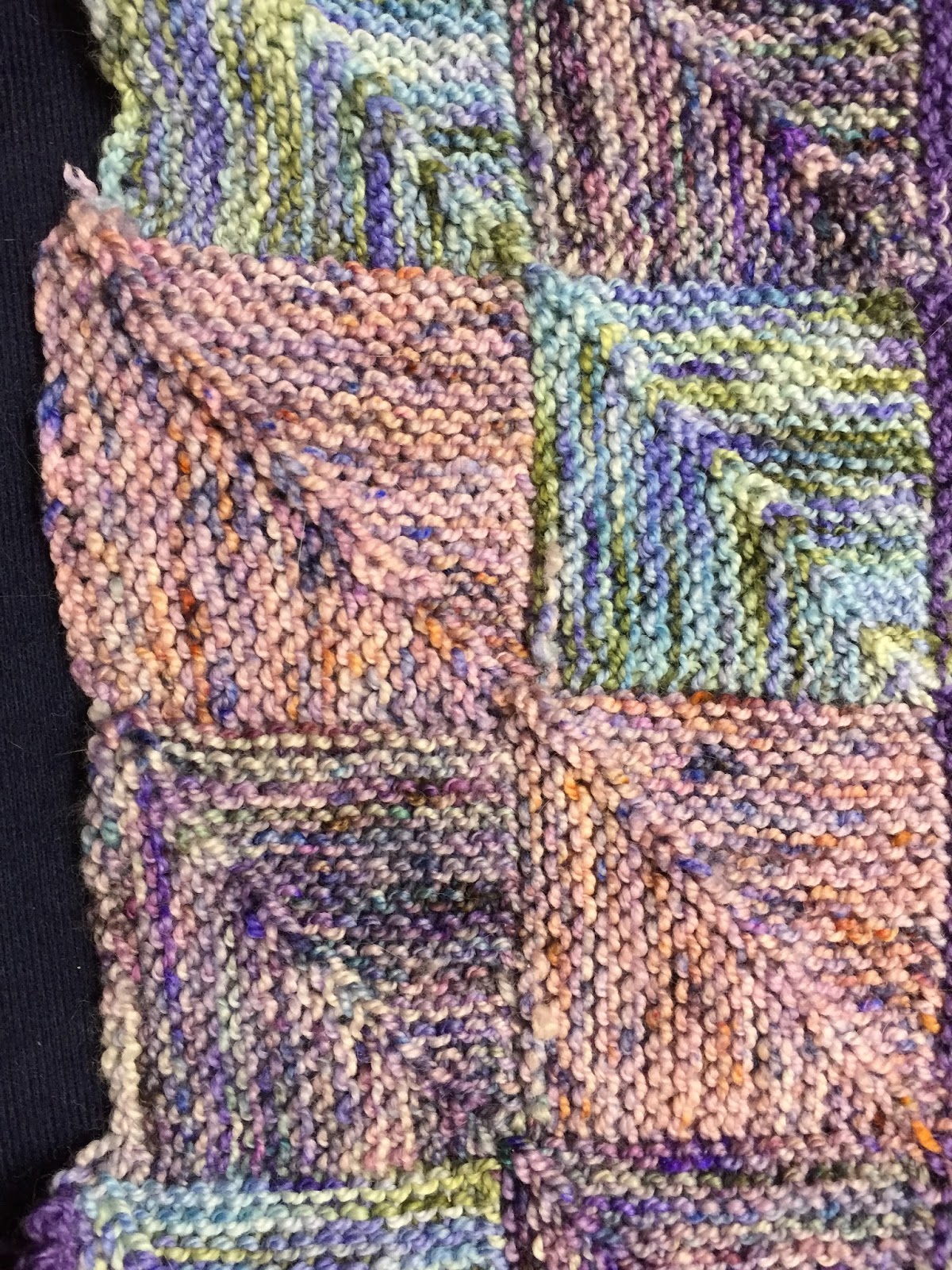
I had seen a darling little mitred-square sweater and thought it would be perfect for our granddaughter. And as a bonus, it fit the bill as a 'don't-think-and-just-knit-it' project. My only concern was that the pattern is a single size. Considering E, I wanted the sweater to be slightly larger. (Yeah, yeah. I know. I've already passed from the no-thinking stage.) 

I added the equivalent of two rows to each square and, based on the measurement of my first square, started knitting. 

The sweater is working up beautifully, but I'm fairly sure that my gauge is slightly larger than the sample. I didn't worry that it would be too big--she's growing fast--only that I would run out of yarn. I didn't, but just barely. I'm using Koigu yarn in three color variations and oddly, the pink variegated color is ever so slightly larger than the other two. It feels that way in the hand and it's consistently knitting a slightly larger square no matter how tight I try to knit it. 

The only thing I'm not crazy about are the edges so I plan to add a finish to all the edges. The pattern suggests a row of single crochet, but I'm thinking about an i-cord edge. 

*Update: I'm putting a double crochet border on the bottom and single crochet on the fronts and neck.

Note to self: Even with a pattern, there is such thing as a 'don't-think-and-just-knit-it' project.

Thursday, September 17, 2015

Fiber and friends

Exhilarating and exhausting, fiber festivals provide rich experiences.

Marudai with 16 bobbins
If you've been to one fiber show, you've been to one fiber show. There are many shows and they all share the common thread of enthusiasm, but each is unique, reflecting its location, organizer and attendees. For smaller shows, in particular, this is the place to find local craftspeople with products. Kind of like farm markets for fiber. 

The business model is not new. Plan an event and capitalize on access to the target market--in this case, sheep and wool. Selling booth space to vendors who serve that market is the simplest and, at a minimum, event organizers underwrite operational expenses with booth sales. 

I'm not privy to the Garden State Sheep Breeders' business plan for its 21st annual Garden State Sheep and Fiber Festival, but I suspect they're happy to break even.

A convenient festival

Last weekend featured near-perfect weather for the Festival held just north of Lambertville, NJ. Unlike 2014 when the weather was brutally hot, the weather this year was near perfect. Only a couple of downpours marred the clear, fall days. 

One attendee noted the convenience factor. To put that into context, its location is midway between two huge Northeastern region sheep and wool shows--Dutchess County in New York, aka Rhinebeck, and Maryland. Both feature hundreds of vendors, thousands of attendees and millions of products. Great experiences, both, but long drives and large crowds can exhaust the most energetic.

Winter's Past Farm
Garden State Sheep & Fiber Festival 2015
Back to convenience. That assessment was based on three factors. One, the location in Mid-Jersey is easy to get to. Two, crowds weren't overwhelming. There was space to walk and time to talk and to make purchasing decisions. 

And three, the range of offerings from the nearly 80 vendors listed in the show brochure covered just about anything you might want or need to quench your fiber thirst. The number of participating vendors continues to grow, filling two barns this year. 

There were educational experiences and lots of inspiration. Plenty of yarn, fleece, roving, tools and equipment. Add to that a host of competitions, sheep shows and demonstrations--cooking, shearing, sheep dog herding, and more. Even if you weren't shopping for yarn (can't imagine that!), the Festival offers a day for family fun. (And, no, I have no ties to the group.)


Behind the (non-existent) counter

Kris planned to simplify set-up this year. She did it and in the process, opened up the space for browsers, for serious buyers, and for folks who stopped by to say, "Hello" or to chat. We both liked the configuration.

Pat, an online spinner friend
For me, there are three main reasons for being at a show like this. One, I am inspired. That's a big one. Two, I get to share my fiber love with other like-minded people. 

And three, I can stand in one place and meet both old friends and new. There are some I only see rarely and others I've met online. I was pleased to see Kae--the one who crocheted the beautiful shawl in autumn colors for the 4-H Fair last month--but furious with myself that I didn't take a photo! Especially since she sports an edgy new hair do. 

Another highlight was Pat. We share a history of learning to spin rather independently. Although we live near each other, we had never met in person. I was so pleased she stopped by.

The morning after

I hate to admit it, but I hereby publicly confess: I felt the weekend feat on Monday. But a couple of good nights' sleep later, my enthusiasm is growing fast for the upcoming the King's County Fiber Festival on Oct. 10 in Brooklyn. Love that show. Love the street, i.e., people traffic. But even more than the fiber fun, the all time highlight is seeing family who live there! 

Near Brooklyn? Do stop and see us! 

Thursday, September 10, 2015

Everyday braids

"Fiona"
Photos: Maurice Marietti

Braids to complement your handwork..or you!

Kumihimo braids may be linked to Japanese Bushi warriors or associated with tea ceremonies or as obijime, but those are historic links. And those uses, functional and/or beautiful as they may be, were not what drew me to the craft when introduced to it more than 30 years ago. 

I loved kumihimo primarily because of its possibilities. I see it as a natural extension of other handcrafts--especially weaving, knitting and sewing.

Wherever  a braid or cord might be used, why not make it beautiful? Think for a minute where you see or use braids--or cords. Just to name a few, there are braids in soft furnishings, clothing decoration, closures, and jewelry. Use kumihimo braids to complement your handcrafted work. I've made braids for use as closures for clothing; cord edgings to complement handwoven pillows; made buttons for a mother-of-the-bride dress; utilitarian cords on my binoculars; and unique jewelry--necklaces, pins, earrings and bracelets. Oh the possibilities!

"Emilia" kumihimo choker. 
I, too, first learned on a handheld circle. For me, it was a heavy cardboard circle with slashes. I liked the potential and quickly moved to a marudai, which M made for meWhen we came back to the States, I led workshops and because marudais and bobbins were virtually non-existent, we supplied them. M made--and sold--many marudais. He also designed a bobbin that eliminated the problem of exposure to lead, as that a common weight material at the time. (We no longer supply these items.)

Although the Internet has facilitated access to marudai and bobbin suppliers, the growth of braiding has mainly occurred through the introduction of stiff foam disks. Like my heavy cardboard prototype, the disks provide a low-price point introduction to the craft. Try it. See if you like it. Experience making braids--and consider their versatility.

It's true that that the proper tools provide the best experience. And it's true for the handheld disk, which cannot provide the control and limits the types of braids possible on a marudai with weighted bobbins, but it's a great start. And for those who only want to make the occasional braid, it's an ideal tool for their craft box.

Beyond silk

"Nadia" kumihimo necklace.
Kumihimo braids and silk were meant for each other. And silk is absolutely lovely to work with. But it's certainly not the only suitable fiber. Anything that can be wound on a bobbin is suitable for me. In addition to silk, I've braided with wool yarn, threads of all sorts--sewing, rayon, embroidery, perle cotton, metallic--and cords. The options are limited only by your imagination--and the size of your bobbins.

I am most enthusiastic about contemporary uses for these beautiful braids and can't keep my enthusiasm to myself. Developing easy-to-use fibers and directions suitable for beginners working on foam disks has been one way to share that love. 

"Fiona" (16) Shawl pin
I'll be introducing several kumihimo kits at this weekend's  Garden State Sheep Breeders 21st Annual Sheep and Fiber Festival in Lambertville, NJ.  

The two necklaces I've chosen as kits are based on necklaces I've made and love to wear. The simplest design, "Emilia," is perfect under a V-neck shirt or blouse. "Nadia" draws more attention and definitely makes a statement. Looking for that perfect shawl pin? "Fiona" can complement a handcrafted shawl or scarf or can be a brooch. It also makes a beautiful bracelet. Your call!

Like last week's post, the challenge is providing directions that are easy-to follow and suitable for beginning braiders. I'll look to you for feedback. Comment here or email me!

If you are in the Mid- to South Jersey region, consider attending the Festival. I'll be at  Winter's Past Farm. Do stop by and say 'Hello!' 

**Want to know more about kumihimo? Make plans to spend an afternoon braiding with me Oct. 25, 2015 at Woolbearers in Mt. Holly, NJ.**

Thursday, September 3, 2015

Two ways of thinking

What the right brain creates, the left brain must execute.

The Peacock's Gift.
Model: Lauren Valletutti. Photo: Maurice Marietti
My right brain bubbles with ideas for projects--scarves, jackets, sweaters, shawls--you name it. The thread is a major catalyst and often dictates the design. 

Threads on shelves and threads in my hand all but 'talk' to me--and keep up the 'talk' throughout the project. All that talk becomes notes of where the threads went and how. But even with a pretty well documented page or two of notes and sketches, I find transforming my notes into directions that others can easily follow requires an entirely different way of thinking. 

I need to turn off my right-brain thinking, which is  largely visual and wordless, to tap into the left-brain's strengths of logic, language and math. The transition is rarely seamless. Not for me, anyway.
Waterways cowl/scarf
Model: Lauren Valletutti. Photo: Maurice Marietti

The editor: a powerful ally

But that's why editors are so important and why all good writers value them. They are the people behind the byline, the ones who make writers look their best. 

Many years ago, I took a workshop with Ben Yagoda and one thing he said has stuck with me. He worried, he said, that editors weren't editing his work as aggressively as they did when he was an unknown writer.  

I have always been grateful to an editor's keen eye. As he or she picked apart pronouns and verb tenses, questioned details that seemed clear to me, and found niggling formatting issues that bedevil most written work, they always made me look better. 

I still crave an editor's oversight and the questions and corrections. Finalizing patterns for The Peacock's Gift' (above right) and 'Waterways' cowl (left) that I plan to release at the upcoming Garden State Sheep & Fiber Festival (next weekend!), I was hesitant to publish them, worried about possible errors, so I am especially thankful to Kris, an extraordinary knitter and designer and an editor with a sharp editorial eye. 

I hope I'll see you next weekend at the 21st annual Festival. Do stop by Winter's Past Farm  and say 'Hello!'