Project swatches, planning swatches and swatches "just because"
 |
| Swatch for Pine Tree, Version I with labeled tag |
No more. Now I'm an inveterate swatcher -- and not just for gauge. It's essential to my designs.
 |
| Knit swatch attached to directions |
For knitting, I am a huge Barbara Walker fan and her Treasury series of pattern books, a four book compendium crammed full of ideas and possibilities. Although a photo accompanies each pattern, the knit swatch often doesn't live up to the photo. Trust me on this one.
Periodically, I go through the pattern books and mark the ones that look interesting. I copy the directions and paste each to a 4x6" index card. Then, when I'm too tired to do much else, I'm traveling or I'm between projects, I work my way through my patterns of interest.
I like to knit 4 to 6 inch square swatches and label each with the name of the pattern, the book and page number on small white tags. After soaking and blocking them, I attach the cards and they become part of my ever growing library of possibilities.
And, yes, I have other libraries, including braids, woven swatches, and dyed yarn. They not only are sources of inspiration and points of departure for projects, but if I've documented the work, I'll have laid the groundwork for what works, what doesn't and yardage.
Working without a swatch
Recently, I've had my head down working on my own knit and braid designs and really needed to just make some thing that required little more than following directions.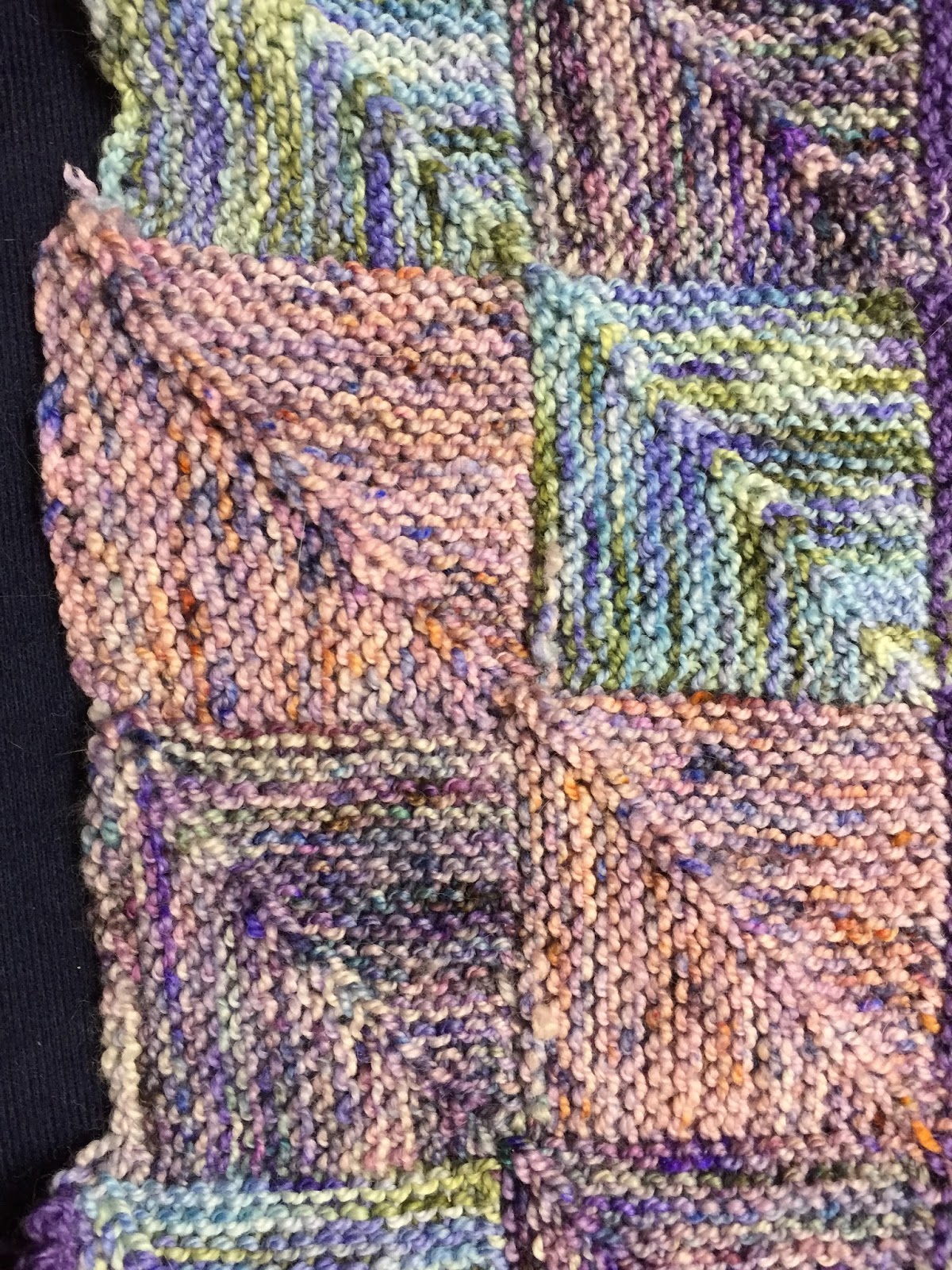 |
| Note the size variation in the pick yarn |
I added the equivalent of two rows to each square and, based on the measurement of my first square, started knitting.
The sweater is working up beautifully, but I'm fairly sure that my gauge is slightly larger than the sample. I didn't worry that it would be too big--she's growing fast--only that I would run out of yarn. I didn't, but just barely. I'm using Koigu yarn in three color variations and oddly, the pink variegated color is ever so slightly larger than the other two. It feels that way in the hand and it's consistently knitting a slightly larger square no matter how tight I try to knit it.
The sweater is working up beautifully, but I'm fairly sure that my gauge is slightly larger than the sample. I didn't worry that it would be too big--she's growing fast--only that I would run out of yarn. I didn't, but just barely. I'm using Koigu yarn in three color variations and oddly, the pink variegated color is ever so slightly larger than the other two. It feels that way in the hand and it's consistently knitting a slightly larger square no matter how tight I try to knit it.
The only thing I'm not crazy about are the edges so I plan to add a finish to all the edges. The pattern suggests a row of single crochet, but I'm thinking about an i-cord edge.
*Update: I'm putting a double crochet border on the bottom and single crochet on the fronts and neck.
Note to self: Even with a pattern, there is such thing as a 'don't-think-and-just-knit-it' project.
*Update: I'm putting a double crochet border on the bottom and single crochet on the fronts and neck.
Note to self: Even with a pattern, there is such thing as a 'don't-think-and-just-knit-it' project.


