Showing posts with label sweater. Show all posts

Monday, April 20, 2015

Fisher knitwear

Michael Pearson's Traditional Knitting
Like most textile arts, knitting was not historically an art form. It was a practical craft. In the British Isles, knitting sweaters, commonly known as ganseys, was what people did to clothe themselves and often to make a few shillings on the side. The knits for fishermen provided warmth in harsh environments, but they also were palettes for creative and talented knitters. 


Traditional patterns often passed from mother to daughter, but were rarely written down. Almost certainly, some of this history has already been lost. We can thank Michael Pearson for helping to preserve the history. And now, we can thank Dover Publications for reissuing an expanded edition of Michael Pearson’s Traditional Knitting, Aran, Fair Isle & Fisher Ganseys, which was first published in 1984. 

This book is a classic and of interest to anyone interested in knitting for the author includes not only historical perspectives and photographs, but tips and patterns for the modern day knitter.


Pearson considers the origins of the name ‘gansey,’ as well as the patterns used. Where did they originate? Can you identify the village or family by the pattern, as is often claimed? Some of these questions can be answered straightaway, but many must be assigned to the category of ‘probability.’

One at a time

It was almost too late when Pearson embarked upon his project to find and document knitwear in fishing villages and communities in Great Britain. In some cases, he was too late, in which case he relied on those who preceded him as well as some collections and  local museums. The knitters he met were like most knitters today--gracious and eager to share. He only had one instance of refusal.

Compiled from personal interviews with knitters and their descendants in fishing villages around the coast of Great Britain, Pearson documents a history of personal and contract knitting among coastal fisher families in the British Isles. Knitters will find a wealth of inspiration and patterns. 

The southern English fisher ganseys show many beautiful patterns in variations of knit and purl, but when Pearson gets to Scotland, he is awed. He says, “the Scottish knitters were more creative and adventurous and their patterns much more exciting. It seems there has been little or no influence northwards from England.”

Practical tips and how-to’s

In addition to history, Pearson provides complete patterns along with knitting tips and how-to’s throughout the text. For example, to resolve a common problem of an unsightly column of stitches where the knitter changes needles in knitting in the round, he advises varying the crossover point to even the tension. 
"Never, ever sew when you can knit." (Quote from one interviewed knitter.) 

After reading the section of Fair Isle knitting, I'm ready to discard my pseudo-‘Fair Isle’ sweater, which is far from the traditional style. The photographs in this section are particularly beautiful, showing examples of the patterns within patterns and vivid color work. I particularly liked the color photograph of Fair Isle knit in the varying natural shades of Shetland ranging from the darkest brown to Shetland white.

I really enjoyed reading this book and now need to find a place for it on my reference shelf. It’s that good.

Tuesday, April 7, 2015

Button, button

One way to avoid the 'homemade' tag

Espresso sweater
So, you've finished knitting something--a garment, accessory, table linen, whatever--and you heave a sigh of relief. You've spent dollars on the yarn and many hours planning and executing the project. And you're proud of it. BUT....it's rarely really and truly done.

You haven't finished it until, well, you've finished it. Those thread ends must be woven in, the  pieces seamed together and the edges finished--all the things that take it from the needles or the loom to a usable item. 

Shortcut the finishing processes at your own peril. No serious handcrafter wants to produce an item that screams 'homemade.' Although 'homemade' works well with jam and pies, it's a killer on handcrafted fiber items. Synonymous with second-rate and poor skills, it degrades the work. 

The importance of attention to detail in finishing simply can't be emphasized enough. It is often the difference between 'homemade' and 'custom made.' 
I recently received a high compliment from a knitting maestro who admired the sweater I was wearing and remarked, 'You could make that.' It was particularly sweet to reply, 'I did.'
Although every single decision--color, creativity, technique, etc.--a skilled fiber artist makes in producing an item contributes to the final product, finishing details are frequently the thing that  separates a 'homemade' look from the far more desirable 'custom,' 'designer,' or 'one-of-a-kind.'

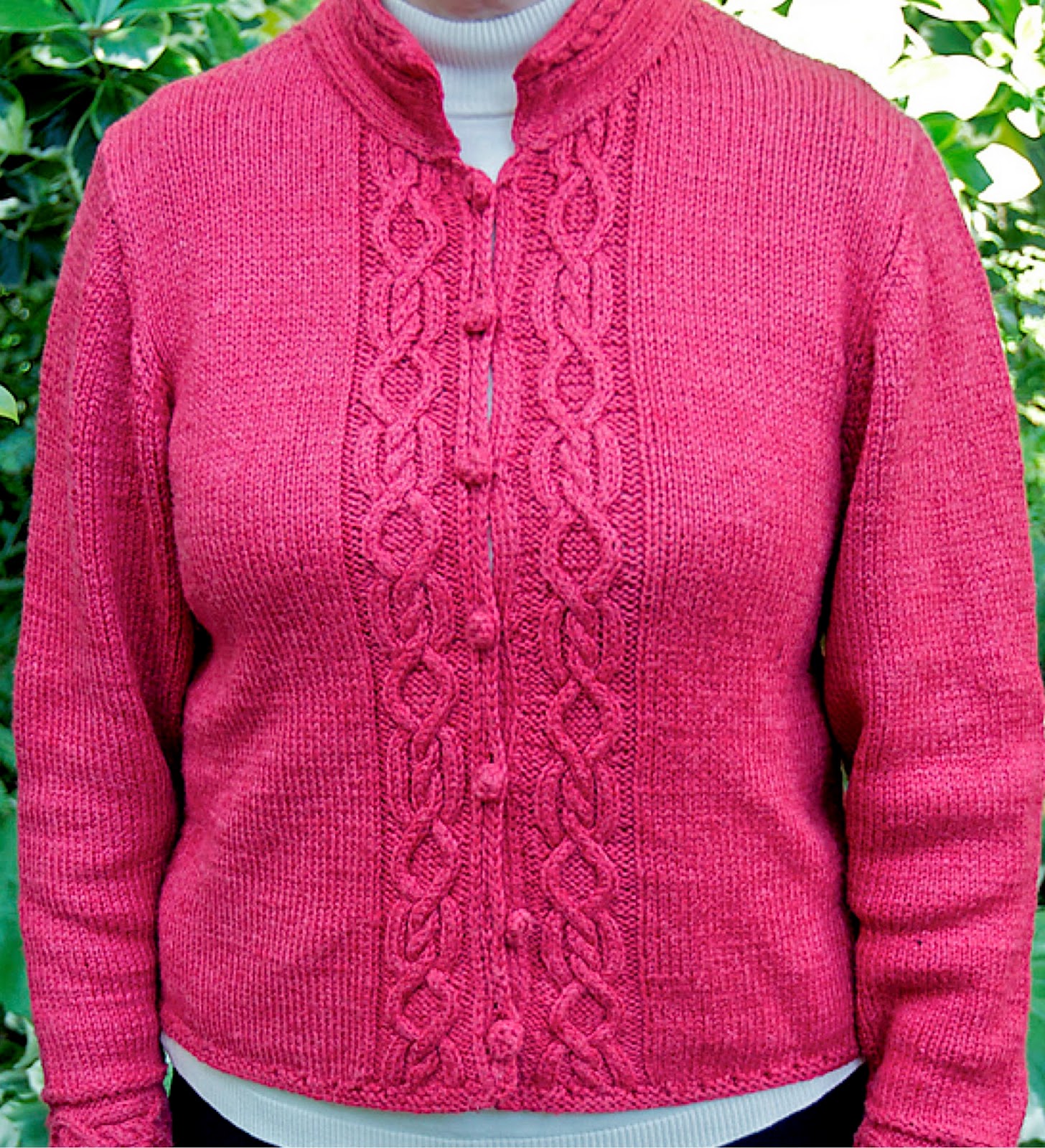
Several years ago, I knit a sweater from Lisa Lloyd's Espresso sweater patternI rarely follow a pattern exactly, so it's no surprise that as I compare the original with mine as posted on ravelry, there are visible departures from her well-designed pattern. My changes were largely restricted to the edgings and finishing.

Since posting the photo, the buttons have garnered the most comments. The very simple directions for making the buttons are in the note section of on my ravelry project page, but I'm posting them here, as well, along with some additional thoughts on buttons.

Buttons: A closure or the focal point?

Dorset button
The distinction is important. Sometimes, you want to show off the button...and sometimes, not. Most often I want a button that complements, but doesn't distract. I want the focus on the garment. Usually, I make buttons from the same yarn as my garment. 

Probably the most commonly known handmade button is the Dorset button, which is worked over a plastic or metal ring. I rarely use this style as it's a rather large button when worked over most available rings. Sure, smaller rings are an option, but I find them  tedious and unless using very fine yarn, the resulting button can look unprofessional.

Espresso sweater, buttons
Most often I crochet buttons using the same yarn that was used to make the garment. Whether I make them using a button as a base depends solely on the yarn and the garment. Crocheting a button over a button with a shank and in a color that won't shout through the cover makes a button with a solid feel. 

The Espresso sweater buttons, shown at left, do not have a button base. They are roundish, soft and pliable. I first made the buttons over a button base, but didn't like the look, so I removed the button to achieve a softer look. Directions for both versions are below.

(You may also note that the finished edges on this sweater differ from the original pattern. The sleeve edges are finished in one row of single crochet and the front edges with multiple rows of Bosnian crochet, incorporating loops to accommodate the crocheted buttons on the right front.)

Ready to make your own buttons? Here's my very simple approach:


Directions for round crocheted buttons

[To make a button with a solid button base, you will need 3/8 inch shanked buttons, domed with a flat base]

Using a small crochet hook, appropriate for the yarn you are working with:
  • Make an overhand circle without a knot
  • Make 5 *SC in circle, ensuring that overhand is secure. Pull up to tighten.
  • Make 2 SC in the back of each of the 5 sts in prior row
  • Make 1 SC in the back of each of the 10 sts in prior row
  • Pick up 2 sts from back (1st from front, 2nd from back; crossed sts) and slip stitch to securely close.
[If using a button base, insert button and slip stitch to securely enclose the button.]

*SC, single crochet